
Introduction:
If you are tired of reaching for your spectacles every morning or constantly worrying about contact lenses, you may have wondered whether laser vision correction could give you greater freedom from glasses. Bladeless laser eye surgery has become one of the most talked-about approaches to vision correction because it uses laser technology rather than a traditional surgical blade for key steps of the procedure. But what exactly does “bladeless” mean, how does the treatment work, and is it suitable for everyone?
Bladeless laser eye surgery is not a single procedure. The term is commonly used to describe laser-based refractive procedures such as femtosecond-laser LASIK and, in a different surgical technique, SMILE. The exact technology used depends on the procedure, the patient’s prescription, corneal thickness and shape, eye health, lifestyle and the surgeon’s assessment. Modern laser platforms can be highly precise, but precision alone does not make someone a suitable candidate. A detailed preoperative examination remains one of the most important parts of safe refractive surgery.
The technology has also continued to evolve. For example, the U.S. FDA maintains approvals for specific laser systems and specific refractive indications rather than treating every laser procedure as interchangeable. Current FDA records include femtosecond-laser technology used for SMILE and excimer-laser systems approved for LASIK within defined prescription ranges and patient criteria. This is why choosing an experienced refractive surgeon and undergoing proper screening is more important than simply choosing a procedure because it is advertised as “bladeless”.
What Is Bladeless Laser Eye Surgery?
Bladeless laser eye surgery refers broadly to refractive eye surgery in which lasers are used to perform important surgical steps instead of a manually operated surgical blade. In traditional LASIK, a mechanical microkeratome may be used to create the corneal flap. In femtosecond LASIK, a femtosecond laser creates that flap with computer-controlled laser pulses. The excimer laser then reshapes the cornea according to the patient’s refractive correction. This combination is commonly described as bladeless LASIK or all-laser LASIK.
The basic goal is simple: change the shape of the cornea so that incoming light focuses more accurately on the retina. Think of the cornea as the eye’s front optical window. If its shape causes light to focus in front of or behind the retina, you may experience myopia, hyperopia or astigmatism. Laser vision correction changes the corneal curvature in a carefully calculated way to compensate for that refractive error.
The word “bladeless” should not be misunderstood as meaning that no tissue is affected. Refractive surgery still involves controlled alteration of corneal tissue, and every surgical procedure has potential risks. The advantage of modern laser technology is that the surgeon can use highly controlled systems to create and reshape tissue according to a treatment plan. The FDA specifically advises patients to check whether the particular laser being considered is approved for their type of refractive error and treatment.
How Bladeless Technology Works:
In femtosecond-laser LASIK, a femtosecond laser creates the corneal flap instead of a mechanical blade. The flap is gently lifted so that the underlying corneal tissue can be reshaped with an excimer laser. After the reshaping is completed, the flap is repositioned and naturally adheres during healing. The treatment pattern can be based on the patient’s prescription and, depending on the technology and treatment plan, additional measurements of the cornea and visual system.
The femtosecond laser and excimer laser perform different jobs. The first creates the flap, while the second removes microscopic amounts of corneal tissue to alter its curvature. This is different from SMILE, where a femtosecond laser creates a small lens-shaped piece of tissue called a lenticule within the cornea, which is then removed through a small opening. ZEISS describes SMILE as a flapless and bladeless procedure, with an opening of approximately 4 mm.

Types of Bladeless Laser Eye Surgery:
When someone searches online for “bladeless laser eye surgery”, they may actually be looking at several different procedures. The two important categories to understand are a LASIK and SMILE. Both use laser technology, but they do not reshape the cornea in exactly the same way. PRK and related surface procedures are also laser-based, but they have a different surgical approach and are not generally what people mean when they specifically search for bladeless LASIK.
Bladeless LASIK:
Bladeless LASIK, also known as femtosecond LASIK, replaces the mechanical blade traditionally used for flap creation with a femtosecond laser. After the surgeon creates and lifts the flap, an excimer laser reshapes the cornea to correct the refractive error. The surgeon then repositions the flap.
The major appeal is the combination of two sophisticated laser technologies. The femtosecond laser provides computer-controlled flap creation, while the excimer laser performs the corneal reshaping. Depending on the patient’s eyes and the equipment available, treatment may incorporate wavefront-guided, wavefront-optimised or topography-guided planning. The best treatment is therefore not necessarily the newest-sounding treatment; it is the treatment that matches the patient’s eye measurements.
SMILE and SMILE Pro:
SMILE, or small incision lenticule extraction, is another minimally invasive laser vision correction procedure. Instead of creating a LASIK flap, the femtosecond laser creates a lenticule inside the cornea. The surgeon removes that lenticule through a small incision, changing the corneal shape and correcting the refractive error.
The FDA has approved the VisuMax femtosecond laser for SMILE for specified myopia and astigmatism indications, including defined prescription ranges and patient criteria. The approved indications have also been updated over time, so patients should not assume that every SMILE system treats every prescription.
Newer platforms such as ZEISS SMILE pro are designed to make the procedure highly streamlined. ZEISS reports that its SMILE pro platform uses the VISUMAX 800 and can complete the laser treatment portion in less than 10 seconds for myopic treatments under its stated conditions. The actual appointment, however, includes preparation, positioning, treatment and post-operative assessment, so patients should not interpret the laser time as the total clinic time.
Bladeless LASIK vs Traditional LASIK:
The key difference between bladeless LASIK and traditional LASIK is how the corneal flap is created. Traditional LASIK may use a mechanical microkeratome, while bladeless LASIK uses a femtosecond laser. Both procedures then rely on laser-based corneal reshaping, usually with an excimer laser. The choice should be based on clinical suitability, available technology and the surgeon’s assessment rather than marketing language alone.
| Feature | Traditional LASIK | Bladeless LASIK | SMILE |
|---|---|---|---|
| Flap | Mechanical microkeratome | Femtosecond laser | No LASIK flap |
| Main laser technology | Excimer laser + mechanical flap creation | Femtosecond + excimer laser | Femtosecond laser |
| Tissue removal | Corneal reshaping | Corneal reshaping | Lenticule removal |
| Incision | LASIK flap | LASIK flap | Small incision |
| Typical use | Selected refractive errors | Selected refractive errors | Particularly established for myopia ± astigmatism |
| Recovery | Generally rapid | Generally rapid | Generally rapid |
| Suitability | Individual assessment | Individual assessment | Individual assessment |
It is important to remember that bladeless does not automatically mean safer for every person. Corneal thickness, topography, tear-film health, prescription stability, pupil characteristics and other factors can influence the risk-benefit calculation. A procedure that is excellent for one patient may be inappropriate for another.
Who Can Consider Bladeless Laser Eye Surgery?
People who are dependent on spectacles or contact lenses because of myopia, hyperopia or astigmatism may be interested in laser vision correction. However, having a refractive error does not automatically make someone a candidate. Doctors generally look for stable vision, healthy eyes and sufficient corneal tissue, while also considering age and other individual factors.
The exact eligibility criteria vary according to the procedure and laser platform. For example, current FDA labelling for certain LASIK systems specifies minimum age requirements and stable refraction over the preceding year, while approved prescription ranges differ between devices. This demonstrates why a generic statement such as “anyone with spectacles can have LASIK” is misleading.
Common Vision Problems Treated:
Myopia, commonly called short-sightedness, is one of the most common reasons people seek laser vision correction. A person with myopia can usually see nearby objects more clearly than distant objects because the eye focuses light in front of the retina.
Astigmatism occurs when the cornea or another optical surface has an irregular curvature, causing blurred or distorted vision at different distances. Several modern laser procedures can treat selected forms of astigmatism, depending on the patient’s measurements and the specific technology.
Hyperopia, or long-sightedness, may also be treatable with certain laser systems and techniques, but suitability depends heavily on age, prescription and corneal characteristics. FDA approvals show that the permissible ranges differ between devices and procedures, which again reinforces the importance of individualised assessment.
Who May Not Be a Suitable Candidate?
Not everyone who wants to stop wearing glasses should undergo laser eye surgery. A patient may be advised against surgery or asked to postpone it if the prescription is still changing, the cornea is too thin or irregular, there are certain corneal diseases, or there are other conditions that make the procedure unsuitable. Severe or uncontrolled dry eye can also require attention before considering surgery.
Conditions such as keratoconus or suspicious corneal topography deserve particular caution because removing corneal tissue can be inappropriate when the cornea is structurally weak. The same applies to certain ocular surface problems and some systemic or eye-related conditions. A thorough evaluation is therefore not just a formality before surgery; it is a safety filter designed to identify patients for whom laser correction may carry unacceptable risk.
Age also matters, but age alone does not determine suitability. A younger person may have an excellent corneal profile but an unstable prescription, while an older patient may have stable refraction but developing presbyopia or early lens changes. This is why the conversation should be about overall eye health and visual needs, rather than simply asking whether someone is “old enough” for LASIK.
Pre-Surgery Eye Evaluation:
A detailed preoperative assessment is arguably one of the most important stages of laser vision correction. Your spectacle prescription is only one piece of the puzzle. The surgeon needs to understand the shape, thickness and health of the cornea, the quality of your tear film, the stability of your prescription and the overall condition of your eyes.
The evaluation may include refraction, corneal topography or tomography, pachymetry, pupil assessment, tear-film evaluation and a comprehensive eye examination. Some clinics may also perform wavefront measurements or other advanced diagnostic tests when appropriate. These tests help the surgeon determine whether the cornea can safely undergo the planned correction and which procedure is most appropriate.
Tests Performed Before Surgery:
Common examinations may include:
- Refraction testing to determine the exact spectacle power.
- Corneal topography or tomography to evaluate corneal shape.
- Pachymetry to measure corneal thickness.
- Tear film and dry-eye assessment to evaluate ocular surface health.
- Dilated retinal examination, when clinically indicated.
- Pupil assessment and other measurements relevant to treatment planning.
The results are considered together rather than independently. A normal spectacle prescription does not guarantee a normal cornea, just as a good corneal thickness measurement does not guarantee healthy tear-film function. The objective is to establish whether the expected benefit of surgery outweighs the potential risks for that particular patient.
What Happens During Bladeless Laser Eye Surgery?
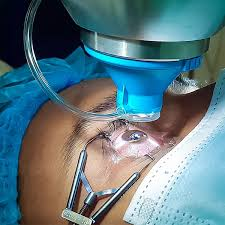
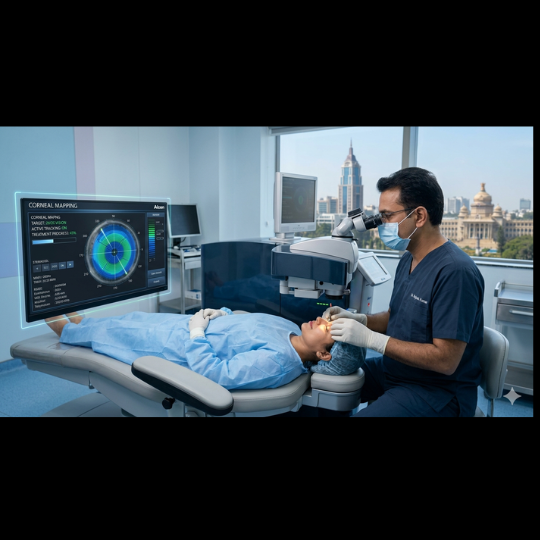
On the day of surgery, the eye is prepared with anaesthetic drops, and the patient is positioned under the laser system. The eye is kept in the correct position using the equipment’s patient interface and tracking systems. In femtosecond LASIK, the first laser creates the corneal flap. The flap is then lifted, allowing the excimer laser to reshape the cornea according to the treatment plan.
The actual laser treatment is generally very short, although the overall procedure involves preparation and post-operative checks. Patients are awake throughout the procedure and are typically asked to focus on a target light. Modern systems incorporate tracking and other technology to help maintain treatment alignment, but patients still need to follow the surgical team’s instructions.
In SMILE, the procedure is different because there is no traditional LASIK flap. The femtosecond laser creates the lenticule within the cornea, followed by its removal through the small incision. ZEISS describes the procedure as creating a lenticule and a small opening, with the opening closing as the eye heals.
Is Bladeless Laser Eye Surgery Painful?
Most patients do not describe the procedure itself as painful because numbing eye drops are used. You may feel pressure or a sensation of touch during certain parts of the treatment, but sharp pain is not normally expected during the procedure. After surgery, some people experience watering, mild burning, gritty sensations, light sensitivity or temporary discomfort.
The experience varies from person to person and also depends on the procedure. Recovery after LASIK is often rapid, while other surface-based laser procedures can involve more discomfort during epithelial healing. SMILE is also designed as a minimally invasive, flapless procedure, and manufacturer information describes visual recovery that can occur as soon as the following day for many patients.
Your surgeon will prescribe the appropriate eye drops and explain what symptoms are expected. Severe pain, significant worsening of vision, increasing redness or unusual discharge should never be ignored. Contacting the treating eye-care team promptly is the safest approach if recovery does not follow the expected pattern.
Recovery After Bladeless Laser Eye Surgery:
One of the reasons laser vision correction is attractive is the relatively quick recovery associated with many modern procedures. Some patients notice improved vision very soon after surgery, while visual clarity may continue to fluctuate or improve over the following days and weeks. The timeline varies depending on the procedure, prescription, ocular surface and individual healing response.
ZEISS states that many SMILE patients can resume daily activities soon after treatment, sometimes as early as the following day, subject to the doctor’s advice. It also recommends avoiding certain activities, including contact sports and dusty or smoky environments, during the early recovery period.
Patients should follow their surgeon’s instructions about eye drops, bathing, swimming, exercise, driving and screen use. Avoid rubbing the eyes, especially during the early healing period. Follow-up visits are important because the surgeon needs to confirm that the cornea is healing properly and that vision is progressing as expected.
Benefits of Bladeless Laser Eye Surgery:
The most obvious benefit is reduced dependence on spectacles or contact lenses. For someone who has worn glasses since childhood, waking up and seeing the alarm clock clearly can feel like a small everyday miracle. For another person, the benefit might be being able to swim, exercise, travel or work without constantly thinking about eyewear.
Bladeless technology also offers precise laser-controlled treatment. In femtosecond LASIK, the flap is created using a laser rather than a mechanical blade. In SMILE, the procedure avoids the creation of a conventional LASIK flap altogether. ZEISS describes SMILE as minimally invasive, flapless and bladeless, and notes that fewer corneal nerves may be disrupted compared with LASIK, which may contribute to fewer dry-eye symptoms in some patients.
However, benefits should always be discussed alongside limitations. Laser surgery does not guarantee perfect vision for everyone, and some patients may still require glasses for particular activities. Presbyopia also develops naturally with age, meaning a person who has excellent distance vision after laser surgery may eventually need reading correction.
Risks and Possible Side Effects:
Laser eye surgery has a strong history of successful use, but it is still surgery. Possible side effects can include temporary dry eyes, glare, halos, fluctuating vision, light sensitivity and difficulty seeing clearly in certain conditions. Some patients may experience under-correction, over-correction or regression of the refractive error.
Rare but serious complications can occur, which is why patient selection and surgical expertise matter. The risks are not identical across LASIK, SMILE, PRK and other procedures. A patient should therefore avoid choosing surgery solely on the basis of price or a promotional claim such as “100% safe”.
The FDA regulates the safety and effectiveness of medical devices for their intended uses, and its records specify the approved indications for individual laser systems. The most responsible approach is to ask your surgeon about the risks relevant to your own corneal measurements and prescription, rather than relying on generic success percentages found online.
Bladeless Laser Eye Surgery Results:
The purpose of refractive surgery is to reduce dependence on corrective lenses by changing the eye’s focusing characteristics. Many appropriately selected patients achieve substantial improvement in unaided vision, but individual outcomes vary. Results depend on the starting prescription, corneal characteristics, treatment plan, age, ocular surface health and healing response.
A useful way to think about laser surgery is that it corrects the optical focusing problem present at the time of treatment; it does not stop the eye from ageing. Someone can have excellent distance vision after surgery and still develop presbyopia later. Similarly, changes in the eye or prescription can occur independently of the original procedure.
This is why responsible clinics avoid promising that every patient will have “perfect vision forever”. A better goal is to determine whether the procedure can safely provide meaningful visual freedom for the individual patient. The pre-operative consultation should cover both the expected benefits and the possibility that glasses may still be needed for some tasks.
Bladeless Laser Eye Surgery vs SMILE:
The comparison between bladeless LASIK and SMILE is especially common because both use advanced laser technology but employ different surgical approaches. Bladeless LASIK uses a femtosecond laser to create a flap and an excimer laser to reshape the cornea. SMILE uses a femtosecond laser to create and remove a lenticule through a small incision.
SMILE is particularly established for myopia, including selected cases with astigmatism, while modern laser platforms have expanded the range of refractive corrections available through different procedures. The appropriate choice depends on the patient’s prescription, corneal anatomy, ocular surface, lifestyle and the surgeon’s assessment. FDA approvals should always be considered at the level of the specific device and indication rather than assuming that one technology covers every prescription.
| Factor | Bladeless LASIK | SMILE |
|---|---|---|
| Corneal flap | Yes | No |
| Femtosecond laser | Yes | Yes |
| Excimer laser | Yes | No |
| Lenticule removal | No | Yes |
| Small incision | No, it uses a flap. | Yes |
| Myopia correction | Common | Common |
| Astigmatism | Selected cases | Selected cases |
| Suitability | Individual | Individual |
There is no universal winner. The best procedure is the one that offers an appropriate balance of safety, effectiveness and visual expectations for the patient’s particular eyes.
Bladeless Laser Eye Surgery Cost:
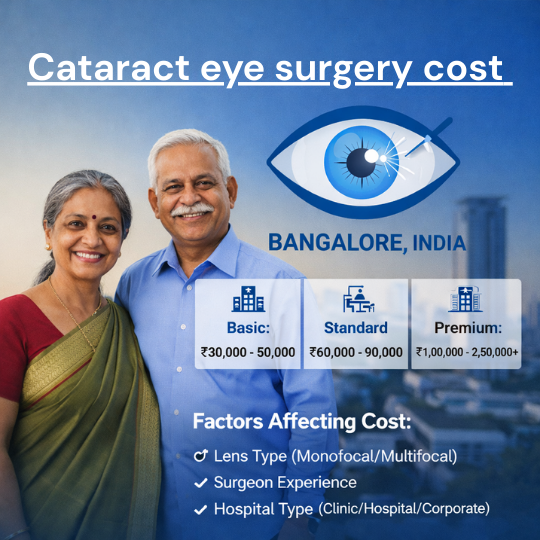
The cost of bladeless laser eye surgery varies significantly between hospitals, cities, technologies and treatment plans. Pricing may depend on whether the procedure is conventional LASIK, bladeless femtosecond LASIK, topography-guided treatment, wavefront-guided treatment or another refractive procedure. The type of laser platform, surgeon experience, diagnostic testing, post-operative care and technology used can also influence the total cost.
Patients should therefore be cautious about comparing two advertised prices without checking what is included. One package might include pre-operative testing, surgeon fees, laser charges, medications and follow-up visits, while another may list only the procedure price. The difference can make an apparently cheaper treatment considerably less comparable than it first appears.
If you are researching laser eye surgery costs in Bangalore, ask the clinic for a complete quotation after your eye evaluation. A reliable consultation should explain the recommended procedure, why it is appropriate, what is included in the package and whether additional treatment or follow-up could incur separate charges. Price is important, but for an elective procedure involving your vision, technology, surgeon experience and appropriate patient selection deserve equal attention.
How to Choose the Right Eye Surgeon:
Choosing the surgeon is just as important as choosing the laser technology. A sophisticated machine cannot replace clinical judgement. Look for an ophthalmologist with appropriate refractive-surgery training and experience, access to modern diagnostic equipment and a willingness to explain both the advantages and limitations of treatment.
During consultation, ask questions such as, ‘Am I a suitable candidate?’ Which procedure do you recommend and why? What does my corneal topography show? Is my prescription stable? What are the risks in my particular case? What happens if I am not satisfied with the visual outcome? These questions turn a sales conversation into a medical discussion.
A good surgeon should also be comfortable telling you when surgery is not appropriate. That may sound surprising, but it is one of the most valuable signs of responsible refractive care. If your cornea is unsuitable or your expectations are unrealistic, the safest recommendation may be to continue using glasses or contact lenses.
Frequently Asked Questions:
1. Is bladeless LASIK completely safe?
No surgical procedure should be described as completely risk-free. Bladeless LASIK uses advanced laser technology and is an established refractive procedure, but complications and side effects can occur. A detailed examination helps identify whether the expected benefits outweigh the risks for an individual patient.
2. Is bladeless LASIK better than regular LASIK?
Bladeless LASIK uses a femtosecond laser instead of a mechanical blade for creating the corneal flap. Whether it is the better option depends on the patient’s eyes, the available technology and the surgeon’s assessment. The word “bladeless” by itself does not guarantee a better visual outcome.
3. How quickly can I return to normal activities?
Recovery varies by procedure and patient. Many people experience useful visual improvement quickly, but the exact timing for driving, exercise, swimming, contact sports and other activities should come from the treating surgeon. For SMILE, manufacturer information indicates that some patients can return to many daily activities as soon as the following day, subject to medical advice.
4. Can bladeless laser surgery correct high spectacle power?
Some modern laser systems can treat a broad range of refractive errors, but the permitted range differs by procedure and device. For example, FDA-approved systems have specific limits for myopia, hyperopia and astigmatism. Your prescription alone is not enough to determine eligibility because corneal thickness and shape are also critical.
5. Can I still need glasses after laser eye surgery?
Yes. Laser vision correction can significantly reduce dependence on glasses, but it cannot guarantee that glasses will never be needed again. Age-related presbyopia, changes in prescription or specific visual requirements can lead to a future need for glasses. The goal should be realistic visual improvement and reduced dependence on corrective lenses rather than an absolute promise of lifelong spectacle independence.
Conclusion:
Bladeless laser eye surgery represents an important development in refractive surgery, replacing mechanical blade-based steps with sophisticated laser technology in procedures such as femtosecond LASIK and SMILE. Modern systems can provide highly controlled treatment, and many appropriately selected patients experience substantial freedom from glasses or contact lenses. At the same time, “bladeless” should not be treated as a guarantee of perfect vision or zero risk.
The most important decision is not simply choosing the newest laser. It is determining whether your eyes are suitable for surgery and which procedure best matches your anatomy, prescription, lifestyle and visual expectations. A comprehensive examination, accurate corneal mapping, stable prescription and discussion with an experienced refractive surgeon are essential before making a decision.
If you are considering bladeless laser eye surgery in Bangalore, start with a detailed eye examination rather than selecting a clinic based only on an advertised price. The right treatment is the one that prioritises the long-term health of your eyes while giving you the best realistic opportunity for improved unaided vision.