
Introduction
In today’s digital-driven world, clear vision is more important than ever. For decades, people with refractive errors such as myopia (nearsightedness), hyperopia (farsightedness), and astigmatism relied on eyeglasses or contact lenses to correct their eyesight. However, the rise of laser vision correction procedures has given millions of people worldwide the freedom from glasses and lenses.
One of the most advanced and minimally invasive procedures available today is SMILE laser eye surgery. SMILE, short for Small Incision Lenticule Extraction, represents the next generation of laser vision correction technology. It offers patients a safer, quicker, and more comfortable alternative to traditional LASIK or PRK procedures, making it increasingly popular among people seeking permanent vision correction.
In this guide, we’ll explore everything you need to know about SMILE laser eye surgery — including how it works, its benefits, risks, costs, recovery, and whether it may be the right choice for you.
What is SMILE Laser Eye Surgery?
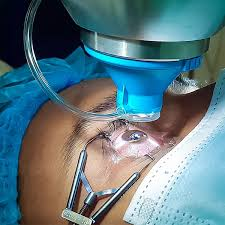
SMILE (Small Incision Lenticule Extraction) is a minimally invasive refractive surgery designed to correct common vision problems such as myopia and astigmatism. Unlike LASIK, which creates a corneal flap, SMILE uses a femtosecond laser to create a small, lens-shaped piece of tissue (called a lenticule) within the cornea. This lenticule is then removed through a tiny 2–3 mm incision, reshaping the cornea and correcting the refractive error.
SMILE was first introduced in 2011 and has since been approved by the US FDA, CE (Europe), and other global health authorities. It has already helped over 5 million patients worldwide achieve freedom from glasses.
How Does SMILE Work? – Step-by-Step Procedure
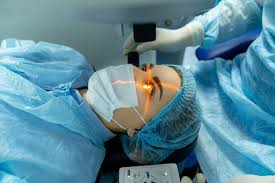
The SMILE procedure is quick, usually lasting 10–15 minutes per eye, and is virtually painless. Here’s a step-by-step breakdown:
- Preparation
- The eye is numbed with anesthetic eye drops.
- The patient is positioned under the laser system.
- Laser Creation of Lenticule
- A femtosecond laser creates a small, disc-shaped piece of tissue (lenticule) inside the cornea.
- A tiny incision (about 2–3 mm) is made in the cornea.
- Lenticule Extraction
- The surgeon gently removes the lenticule through the small incision.
- This reshapes the cornea, allowing light to focus correctly on the retina.
- Completion
- No flap is created, and no stitches are required.
- Vision improves almost immediately, with further clarity developing over a few days.
Advantages of SMILE Laser Eye Surgery
SMILE offers numerous benefits over traditional refractive surgeries:
1. Minimally Invasive
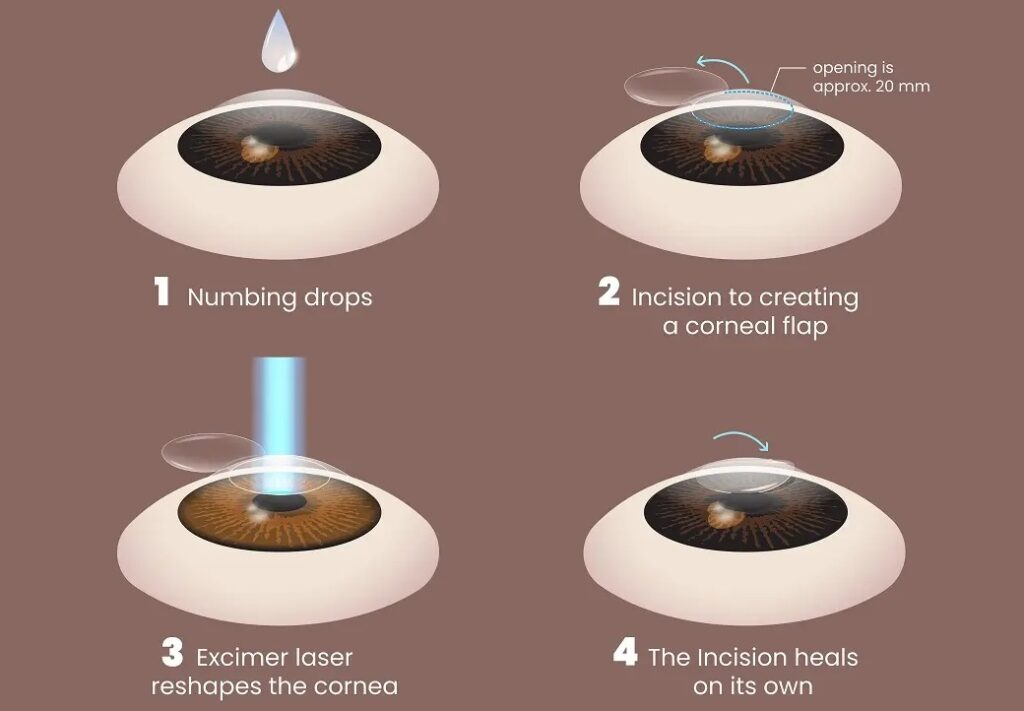
- Only a small incision (2–3 mm) is made, compared to a 20 mm flap in LASIK.
- Less disruption to the cornea means a more stable structure and faster healing.
2. No Flap Complications
- LASIK involves creating a flap, which can lead to flap-related risks like displacement or inflammation.
- Since SMILE does not require a flap, these risks are eliminated.
3. Reduced Dry Eye Symptoms
- SMILE preserves more corneal nerves, reducing the chances of post-surgery dry eye syndrome.
4. High Precision and Safety
- Uses advanced femtosecond laser technology for unparalleled accuracy.
- Effective for correcting myopia (up to -10.00 D) and astigmatism (up to -5.00 D).
5. Quick Recovery
- Most patients notice improved vision within 24–48 hours.
- Minimal downtime compared to other procedures.
6. Better Corneal Strength
- Since no large flap is created, the cornea retains better biomechanical stability.
Who is Eligible for SMILE Surgery?
Not everyone is a candidate for SMILE. A detailed eye examination is necessary, but general eligibility criteria include:
✔ Age: 18 years or older
✔ Stable prescription for at least 12 months
✔ Myopia (up to -10.00 D) or Astigmatism (up to -5.00 D)
✔ Healthy cornea with sufficient thickness
✔ No history of eye diseases like glaucoma, keratoconus, or severe dry eyes
Not Eligible If:
✘ Pregnant or breastfeeding women
✘ Patients with uncontrolled diabetes or autoimmune disorders
✘ Those with corneal scars, infections, or unstable vision
Risks and Possible Side Effects of SMILE
While SMILE is considered extremely safe, like any surgery, it carries some risks. Possible side effects may include:
- Dry Eyes (though less common than LASIK)
- Glare and Halos around lights at night (temporary)
- Under-correction or Over-correction requiring enhancement
- Infection or Inflammation (rare)
- Visual Fluctuations during the healing phase
With proper care and follow-ups, most of these side effects resolve within weeks.
SMILE vs. LASIK vs. PRK – A Comparison
| Feature | SMILE | LASIK | PRK (Photorefractive Keratectomy) |
|---|---|---|---|
| Invasiveness | Minimally invasive | Flap creation required | Surface layer removed |
| Flap Complications | None | Possible | None |
| Dry Eye Risk | Lower | Higher | Moderate |
| Recovery Time | 1–2 days | 1–3 days | 5–7 days |
| Suitability | Myopia & Astigmatism | Myopia, Hyperopia, Astigmatism | Broad range |
| Comfort | Very comfortable | Comfortable | Initial discomfort |
The Recovery Process After SMILE
Recovery is usually smooth and quick. Here’s what to expect:
- First 24 Hours: Mild irritation, watering, or blurriness.
- 48 Hours: Vision significantly improves; most patients can return to normal activities.
- 1 Week: Nearly complete recovery; avoid rubbing eyes.
- 1 Month: Clear, stable vision achieved.
Post-Surgery Care Tips:
- Use prescribed eye drops regularly.
- Avoid swimming, heavy exercise, or dusty environments for at least 2 weeks.
- Wear protective glasses outdoors.
- Follow-up with your doctor as scheduled.
Cost of SMILE Laser Eye Surgery
The cost of SMILE varies depending on country, clinic reputation, and surgeon expertise.
- India: ₹75,000 – ₹1,25,000 per eye
- USA: $2,500 – $4,000 per eye
- UK: £2,000 – £3,000 per eye
Factors influencing cost:
- Surgeon’s experience
- Clinic technology & equipment
- Pre- and post-operative care included
While SMILE may be slightly more expensive than LASIK, the benefits in safety and comfort make it a worthwhile investment for many patients.
Success Rate of SMILE Surgery
Clinical studies show over 95% of patients achieve 20/20 vision or better after SMILE. Patient satisfaction rates are also very high due to:
- Long-lasting results
- Reduced complications
- Minimal discomfort
Is SMILE Right for You?
SMILE laser surgery is best suited for patients with moderate to high myopia and astigmatism, who want a minimally invasive and safe alternative to LASIK.
However, if you have thin corneas, hyperopia, or require a very high prescription correction, your surgeon may recommend LASIK, PRK, or ICL (Implantable Collamer Lens) instead.
Conclusion
SMILE laser eye surgery has revolutionized vision correction with its minimally invasive, flapless, and highly precise technique. It combines the accuracy of advanced femtosecond laser technology with improved safety and faster recovery. For patients with myopia and astigmatism, it offers a comfortable, long-term solution to life without glasses or contact lenses.
If you are considering SMILE, consult with an experienced refractive surgeon to determine whether you’re a suitable candidate. Investing in your vision means investing in your quality of life — and with SMILE, clear vision is just a small incision away.
Frequently Asked Questions (FAQs)
1. Is SMILE painful?
No. The procedure is painless because anesthetic eye drops are used. Some patients may feel mild pressure during the process.
2. How long does the SMILE procedure take?
Around 10–15 minutes per eye, with the actual laser time lasting less than 30 seconds.
3. Can SMILE correct farsightedness (hyperopia)?
Currently, SMILE is FDA-approved mainly for myopia and astigmatism. Hyperopia correction is still under research.
4. When can I drive after SMILE surgery?
Most patients can drive within 1–2 days once their vision clears. Always follow your surgeon’s advice.
5. Will I need glasses after SMILE surgery?
Most patients achieve complete independence from glasses. However, some may need minor corrections for night driving or reading after the age of 40 due to presbyopia.
6. How long do SMILE results last?
Results are considered permanent, although natural age-related changes in the eye (like cataracts or presbyopia) may still occur later in life.