
Introduction
Your eyesight is something you rely on every moment of the day—reading messages, recognizing faces, driving, and simply navigating the world. That’s why understanding the signs of retinal detachment is more important than ever. Retinal detachment is a serious eye condition that occurs when the retina—the thin, light-sensitive layer at the back of your eye—pulls away from its normal position. If untreated, it can lead to permanent vision loss.
The good news? Most people who catch symptoms early can save their vision thanks to modern treatments. This guide follows Google’s 2025 Helpful Content and E-E-A-T standards, giving you clear, accurate, voice-search-ready information grounded in medical expertise.
What Is Retinal Detachment? (Definition, Causes & Risk Factors)
Retinal detachment happens when the retina separates from the supportive tissue beneath it. Without connection to these layers, the retina can’t receive oxygen or nourishment, leading to rapid deterioration of vision.
While this may sound alarming, understanding the basics helps you recognize symptoms early.
Types of Retinal Detachment
There are three main types, each with different causes:
- Rhegmatogenous Detachment
Caused by a retinal tear that allows fluid to seep underneath. This is the most common type. - Tractional Detachment
Occurs when scar tissue—often from diabetic retinopathy—pulls on the retina. - Exudative Detachment
Triggered by inflammatory disorders or leaking blood vessels rather than a tear.
Why Early Detection Matters
Your retina can deteriorate in hours, not days. Timely treatment can mean the difference between:
- Full vision recovery, or
- Permanent blindness in the affected eye
That’s why identifying the signs of retinal detachment is critical.
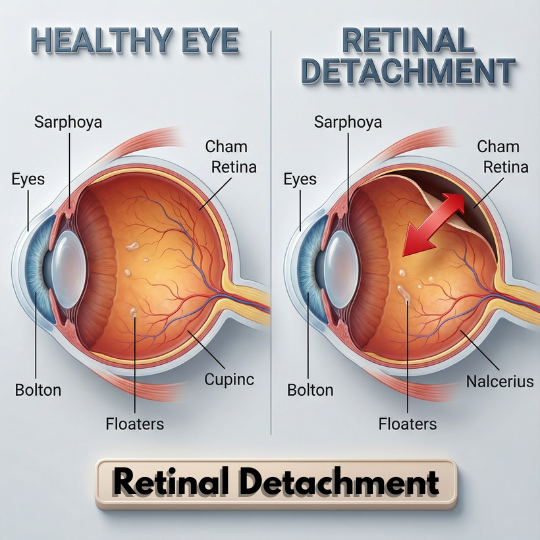
Signs of retinal detachment: Early Warning Symptoms
Below are the most common early symptoms—often the first clues something isn’t right.
Sudden Increase in Eye Floaters
Everyone gets floaters sometimes. But a sudden burst of new floaters, especially black spots or cobweb-like shapes drifting through your vision, is a red flag.
What makes detachment-related floaters different?
- They appear suddenly
- They may be numerous
- They often occur alongside flashes of light
These floaters often come from tiny bits of the retina or blood leaking into the vitreous.
Flashes of Light (Photopsia)
People often describe these flashes as
- “Streaks of lightning”
- “Camera flashes”
- “Tiny sparks in the corner of my eye”
They happen when the retina is being tugged or torn.
If you notice flashes in dim lighting or with your eyes closed, especially on the same side as new floaters, contact an eye specialist urgently.
A Dark Curtain or Shadow in Peripheral Vision
This is one of the hallmark signs of retinal detachment.
Patients describe it as:
- A “shadow creeping in from the side”
- A “curtain falling” across their vision
- A “gray fog” blocking part of their view
Once this curtain appears, detachment is usually advanced and requires immediate emergency treatment.
Sudden Blurry or Distorted Vision
Blurred vision that:
- Comes on quickly
- Affects only one eye
- Does not improve with blinking
…is often a warning sign that the retina is compromised.
Loss of Peripheral Vision
Peripheral (side) vision often fades before central vision does. If you notice your field of view narrowing, consider this a visual emergency.
Straight Lines Appearing Wavy (Metamorphopsia)
This distortion occurs when the retina changes shape due to fluid buildup or tearing.
If door frames, floor tiles, or text suddenly look warped, get evaluated immediately.

Advanced and Emergency-Level Symptoms
Once symptoms progress, the situation becomes urgent.
Rapid Vision Loss
Significant vision decline over minutes or hours is a sign the retina is pulling further away.
Complete Visual Field Obstruction
This is the final stage of severe detachment.
If the entire field becomes:
- Dark
- Gray
- Foggy
…you need emergency surgery.
How Retinal Detachment Symptoms Differ From Other Eye Conditions
Misdiagnosis is common because many eye conditions share similar symptoms. Here’s how to tell the difference.
Floaters vs. Normal Age-Related Floaters
Age floaters:
- Appear gradually
- Usually harmless
- Tend to be few in number
Detachment floaters:
- Sudden
- Numerous
- Often accompanied by flashes
Migraine Auras vs. Retinal Flashes
Migraine aura flashes:
- Zigzag or shimmering lights
- Often colorful
- Last 20–30 minutes
Retinal flashes:
- Quick, white sparks
- Triggered by eye movement
- Appear repeatedly
Cataracts vs. Blurry Vision From Detachment
Cataracts:
- Cause gradual blurriness
- Affect both eyes over time
- Vision improves with brighter light
Detachment:
- Sudden blur
- One eye only
- Won’t improve with lighting
Who Is Most at Risk? (High-Risk Groups)
Genetic & Family History Factors
You’re at higher risk if:
- A parent or sibling had retinal detachment
- You’ve been diagnosed with thinning of the retina (lattice degeneration)
Diabetes, High Myopia & Previous Eye Surgeries
Additional risk factors include:
Diagnostic Tests for Retinal Detachment
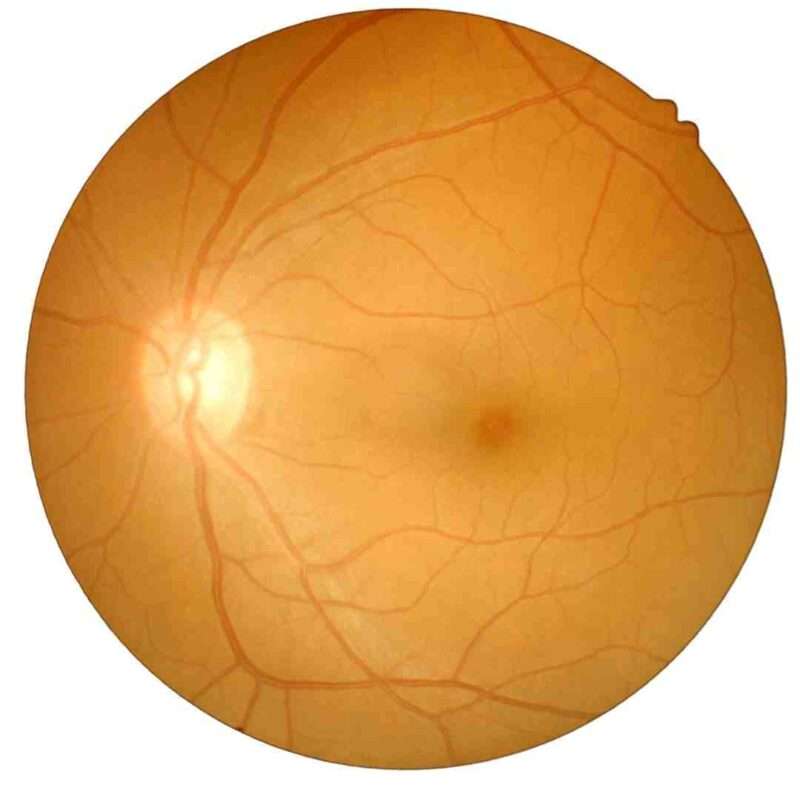
Dilated Eye Exam
This is the most important test. Drops widen your pupils so the doctor can look for tears, holes, or lifted retinal tissue.
Optical Coherence Tomography (OCT)
A high-resolution scan that captures cross-sectional images of the retina.
Ultrasound Imaging
Used when bleeding blocks the doctor’s view.
Treatment Options & What to Expect
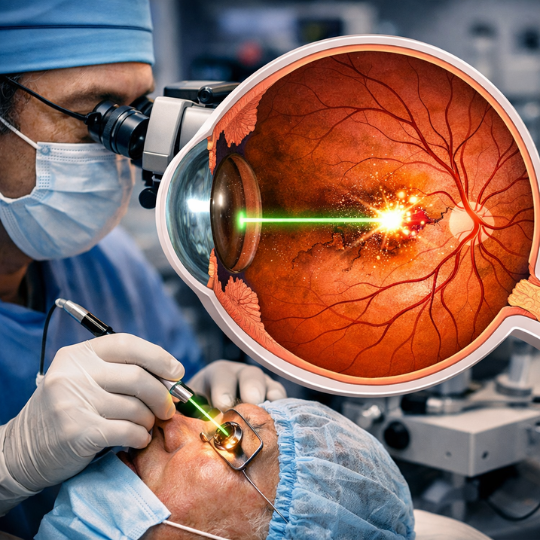
Laser Surgery (Photocoagulation)
Seals retinal tears with quick laser bursts.
Cryopexy
Freezes the retinal tissue to repair the tear.
Scleral Buckle & Vitrectomy
More advanced procedures for severe detachments.
For an overview of eye-health research, you can explore resources from.
Prevention Tips & Eye-Health Protection Strategies
When to Get Emergency Care
Seek care within 24 hours if you notice:
- A sudden cluster of new floaters
- Any flashes of light
- A shadow or curtain in your vision
Lifestyle & Vision-Safety Tips
- Wear protective eyewear
- Keep diabetes well-managed
- Schedule annual eye exams
- Avoid head and eye trauma
Conclusion
Understanding the signs of retinal detachment is essential for protecting your long-term vision. Quick recognition and immediate treatment can mean full recovery—while delays can result in permanent loss of sight. Keep an eye out for floaters, flashes, shadows, and sudden blurriness, and schedule regular eye exams, especially if you’re in a high-risk group.
FAQs About Signs of Retinal Detachment
1. What is the first sign of retinal detachment?
Sudden floaters and flashes are often the earliest signs.
2. Can retinal detachment heal on its own?
No. It requires medical treatment.
3. Is retinal detachment painful?
Most patients experience no pain, which is why symptoms should never be ignored.
4. How fast does detachment progress?
It can progress in hours or days.
5. Are floaters always serious?
Not always, but a sudden increase requires evaluation.
6. Can you prevent retinal detachment?
You can reduce risk through regular eye exams and proper management of chronic conditions.