

Introduction: Understanding High Myopia and LASIK Surgery:
If you’ve been living with thick glasses or strong contact lenses due to high myopia (nearsightedness), you might wonder—can LASIK fix high power like -10 or more?
LASIK, short for Laser-Assisted In Situ Keratomileusis, has revolutionized vision correction by reshaping the cornea to eliminate refractive errors. But when prescriptions reach -10 diopters or beyond, the question becomes more complex.
Let’s explore whether LASIK can handle such extreme cases, what the limitations are, and what safer or more effective alternatives exist in 2025.
What Is Considered “High Power” in Myopia?
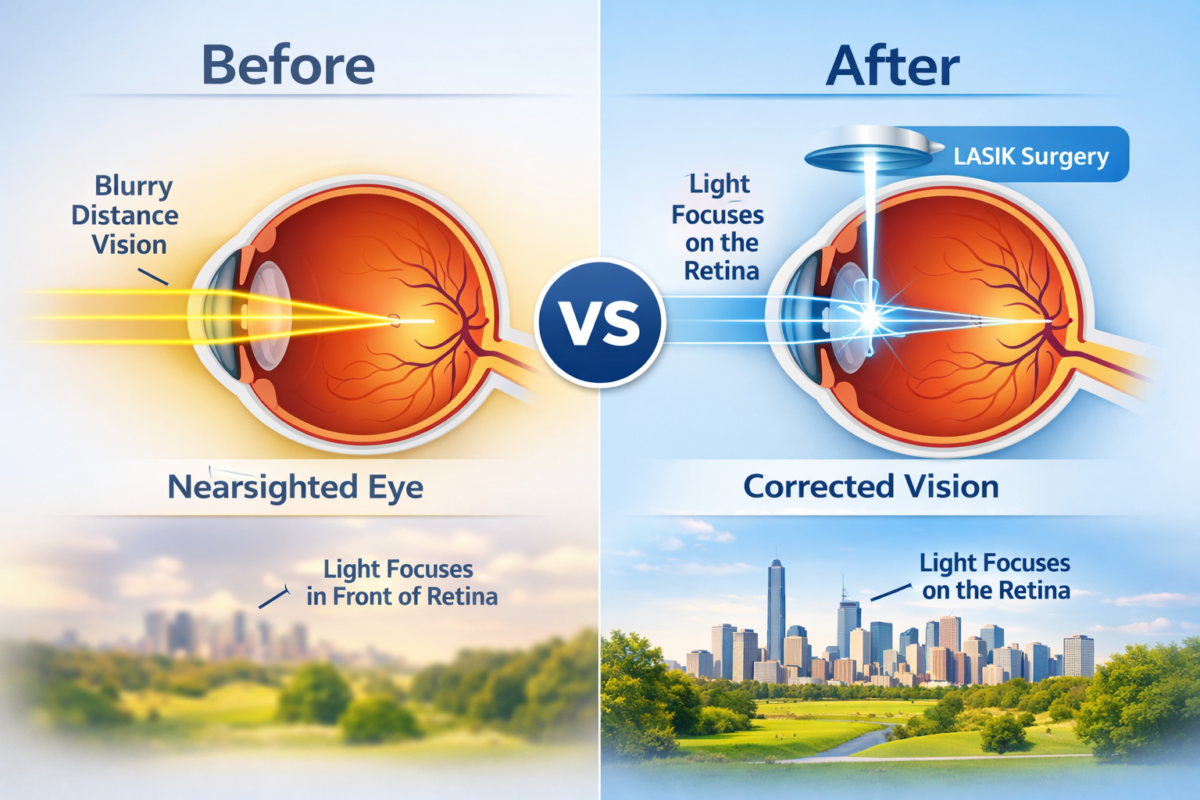
Myopia occurs when the eyeball is longer than normal or the cornea is too curved, causing light to focus in front of the retina.
- Mild myopia: up to -3.00 D
- Moderate myopia: -3.00 to -6.00 D
- High myopia: -6.00 D or more
At -10 or higher, vision is considered severely nearsighted. Patients often struggle to see distant objects even inches away without correction. High myopia also increases risks for retinal detachment, glaucoma, and cataracts—making careful surgical evaluation essential.
How LASIK Works: The Science Behind Vision Correction:
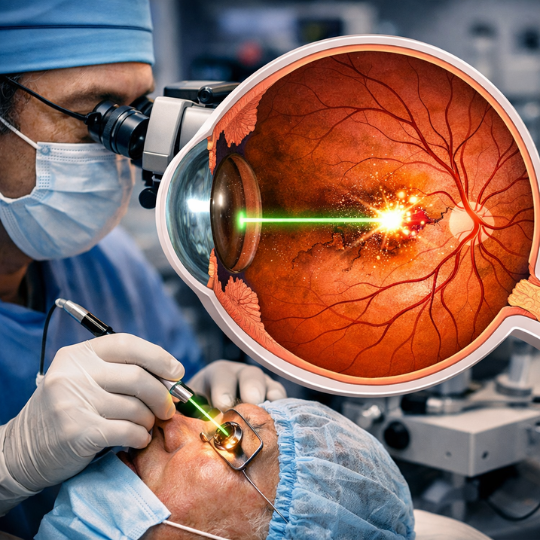
LASIK reshapes the corneal tissue using an excimer laser. A thin flap is created on the cornea, the underlying tissue is sculpted to adjust its curvature, and the flap is repositioned. This process redirects how light enters the eye, allowing clearer focus on the retina.
For moderate prescriptions, LASIK offers excellent accuracy—often achieving 20/20 vision or better. But with higher powers like -10 D, the laser must remove significantly more tissue, posing safety challenges.
Can LASIK Correct Very High Power Like -10 or More?
The Diopter Limits of LASIK Surgery
Modern LASIK typically corrects up to:
- -8.00 D of myopia
- +4.00 D of hyperopia
- 5.00 D of astigmatism
Beyond -8.00 D, surgeons risk removing too much corneal tissue, which can weaken the cornea and lead to ectasia—a bulging complication that distorts vision.
When LASIK May Not Be Suitable for -10 or Higher
For -10 D or more, LASIK is usually not recommended. The main reasons include:
- Insufficient corneal thickness
- High risk of regression or residual error
- Potential for night vision disturbances
- Increased chances of dry eye
However, each patient’s case is unique. Some people with thicker corneas and stable prescriptions may still qualify for advanced LASIK technologies, such as wavefront-guided LASIK or femtosecond laser techniques.
Alternative Procedures for High-Power Correction:
For people with extreme myopia, surgeons now recommend newer and safer vision correction methods that work beyond LASIK limits.
SMILE (Small Incision Lenticule Extraction)
SMILE uses a femtosecond laser to create and remove a lenticule (a small disk of corneal tissue) through a tiny incision.
Advantages:
- No corneal flap required
- Lower risk of dry eyes
- Faster healing
However, SMILE generally treats up to -10.00 D effectively, so borderline cases may still need evaluation.
ICL (Implantable Collamer Lens)
ICL involves placing a micro-thin, flexible lens inside the eye, between the iris and the natural lens. It’s especially beneficial for people with -10 to -20 D myopia or thin corneas.
Benefits of ICL:
- Corrects higher prescriptions than LASIK
- Reversible (the lens can be removed if needed)
- Doesn’t alter corneal structure
For extreme myopia, ICL is often the gold-standard alternative to LASIK.
PRK (Photorefractive Keratectomy)
PRK reshapes the cornea’s surface without creating a flap, making it safer for thin corneas.
Though the recovery period is longer, PRK offers results similar to LASIK for moderate to high myopia.
Factors That Determine LASIK Eligibility for High Power;
Corneal Thickness and Shape
A healthy cornea typically measures 520–550 microns thick. LASIK removes around 12–15 microns per diopter of correction. For -10 D, that means 120–150 microns—which may be too much for safe reshaping if the cornea is thin.
Pupil Size and Eye Health
Larger pupils may increase glare and halos post-surgery. Comprehensive mapping helps determine if LASIK remains a safe option.
Age, Prescription Stability, and Lifestyle
Candidates should be at least 18 years old with a stable prescription for 1–2 years. People with physically demanding jobs, sports activities, or chronic dry eye may benefit more from SMILE or ICL.
Expected Results and Limitations After LASIK:
While LASIK is life-changing, expectations for -10 D or more must remain realistic.
Vision Clarity and Stability Over Time
Even if surgery corrects most of the refractive error, some patients may still need light glasses or touch-ups to achieve perfect vision.
Possible Need for Enhancement Procedures
Enhancements are secondary procedures to fine-tune residual errors after healing. These are more common among patients with higher prescriptions.
Risks and Complications of LASIK for High Power:
Dry Eyes, Glare, and Halos
Temporary dryness and glare at night are common. Artificial tears and anti-glare coatings help manage symptoms.
Corneal Ectasia and Overcorrection Risks
Rare but serious, ectasia weakens the cornea, causing irregular vision. Pre-surgery imaging reduces this risk significantly.
Cost of LASIK for High Power Correction:
When planning vision correction for high myopia, cost plays a major role in deciding the right procedure. Prices vary based on the type of surgery, equipment used, surgeon’s expertise, and clinic location. Below is a comprehensive cost comparison for India and the U.S.
| Procedure Type | Power Range Correction | Approx. Cost (Per Eye in the U.S.) | Approx. Cost (Per Eye in India) | Technology Used | Key Highlights |
|---|---|---|---|---|---|
| Standard LASIK | Up to -6.00 D | $1,500 – $2,500 (₹1.25L – ₹2.10L) | ₹25,000 – ₹45,000 | Microkeratome or basic excimer laser | Best for mild to moderate myopia; not ideal for very high powers |
| Custom / Wavefront LASIK | Up to -8.00 D | $2,000 – $3,500 (₹1.65L – ₹2.90L) | ₹40,000 – ₹65,000 | Wavefront-guided laser mapping | Offers precision and reduces glare; limited for extreme myopia |
| SMILE (Small Incision Lenticule Extraction) | Up to -10.00 D | $2,500 – $4,000 (₹2.10L – ₹3.30L) | ₹60,000 – ₹1,00,000 | Femtosecond laser | No flap; quick healing; ideal for dry-eye patients |
| PRK (Photorefractive Keratectomy) | Up to -8.00 D | $1,800 – $3,000 (₹1.50L – ₹2.45L) | ₹35,000 – ₹55,000 | Surface ablation laser | Safe for thin corneas; longer healing time |
| ICL (Implantable Collamer Lens) | -10.00 D to -20.00 D | $3,500 – $5,000 (₹2.90L – ₹4.15L) | ₹1,25,000 – ₹2,00,000 | Collamer lens implantation | Best for very high myopia; reversible; premium solution |
| Topography-Guided LASIK | Up to -9.00 D | $2,500 – $3,800 (₹2.10L – ₹3.15L) | ₹60,000 – ₹90,000 | Corneal topography laser | Customized mapping for irregular corneas |
Additional Cost Factors:
- City of Treatment: In India, metro cities like Delhi, Mumbai, Chennai, and Bangalore charge slightly more due to advanced technology and specialist surgeons.
- Laser Technology Used: Femtosecond and topography-guided LASIK systems cost more than traditional microkeratome-based methods.
- Doctor’s Expertise: Renowned refractive surgeons often have higher consultation and surgery fees.
- Follow-up Care: Post-surgery checkups, artificial tears, and enhancement procedures may add ₹5,000–₹10,000 ($50–$100) extra.
- Package Deals: Many premium clinics in India offer “All-Inclusive LASIK Packages” that include pre-tests, surgery, and one-year follow-up.
Insurance and Payment Options
- In the U.S.: LASIK is considered an elective procedure, so insurance rarely covers it. However, FSA (Flexible Spending Account) and HSA (Health Savings Account) funds can be used.
- In India: LASIK is also a non-insurance procedure, but most clinics offer 0% EMI (Equated Monthly Installment) plans for 6–12 months.
- Some corporate health plans now partially reimburse vision correction surgery as part of employee wellness benefits.
Cost-Effectiveness Over Time
While the upfront cost of LASIK or ICL might seem high, it can save thousands over time by eliminating the need for glasses, contact lenses, and related maintenance.
| Expense Category | Annual Cost (in ₹ / USD) | 10-Year Estimated Total | After LASIK / ICL |
|---|---|---|---|
| Prescription Glasses | ₹10,000 / $120 | ₹1,00,000 / $1,200 | Not required |
| Contact Lenses + Solution | ₹15,000 / $180 | ₹1,50,000 / $1,800 | Not required |
| Eye Checkups / Lens Replacements | ₹5,000 / $60 | ₹50,000 / $600 | Minimal |
| Total (10 Years) | ₹3,00,000 / $3,600 | Potentially higher than LASIK | One-time cost, lifelong clarity |
Recovery Process and Aftercare Tips:
Immediate Recovery Timeline
- Day 1: Slight burning or tearing sensation
- 1 Week: Vision improves significantly
- 1 Month: Full stabilization for most patients
Long-Term Care for Best Results
Avoid eye rubbing, swimming, and heavy exercise for at least two weeks. Regular checkups ensure early detection of regression.
Conclusion: Is LASIK Worth It for Very High Power?
In summary, LASIK can correct up to -8.00 D effectively, but beyond that — especially -10 or higher — risks outweigh benefits.
For such cases, ICL or SMILE surgeries offer safer, more precise, and longer-lasting outcomes without compromising corneal health.
Always consult a refractive surgery specialist for personalized evaluation. Your ideal treatment depends on your corneal profile, eye health, and long-term visual goals.
FAQs About LASIK for -10 or More Power:
Q1: Can LASIK permanently correct -10 power?
Not always. LASIK may partially correct -10 D but isn’t ideal for extreme prescriptions due to tissue limits.
Q2: Is ICL better than LASIK for high myopia?
Yes. ICL offers safer, reversible correction for very high powers and thin corneas.
Q3: Can SMILE treat -10 power effectively?
SMILE can correct up to -10 D in many cases, but outcomes depend on corneal thickness and eye anatomy.
Q4: How long does LASIK recovery take for high power?
Most vision stabilizes in 2–4 weeks, but full clarity may take up to 3 months.
Q5: Are there risks of blindness with LASIK?
While blindness is extremely rare, complications like infection or ectasia can impair vision if untreated.
Q6: Who should avoid LASIK for high power?
Those with thin corneas, unstable prescriptions, or pre-existing retinal issues should consider ICL or PRK instead.