
You might squint to read a road sign, or perhaps your child moves closer to the TV to see the cartoons clearly. Myopia, commonly known as nearsightedness, is no longer just a “vision quirk”—it is a global health concern. In fact, recent data from the International Myopia Institute suggests that if current trends continue, nearly 50% of the world’s population will be myopic by 2050.
But what actually drives this condition? Is it just your genes, or is it the hours we spend glued to smartphones? As we step further into 2025, the medical consensus has shifted from viewing myopia as a simple refractive error to treating it as a complex condition influenced heavily by our modern lifestyle.
In this guide, we will break down the latest scientific findings on what causes myopia, distinguish myths from facts, and explore how you can manage it—right here in Bangalore.
What Causes Myopia? (Featured Snippet Optimized)
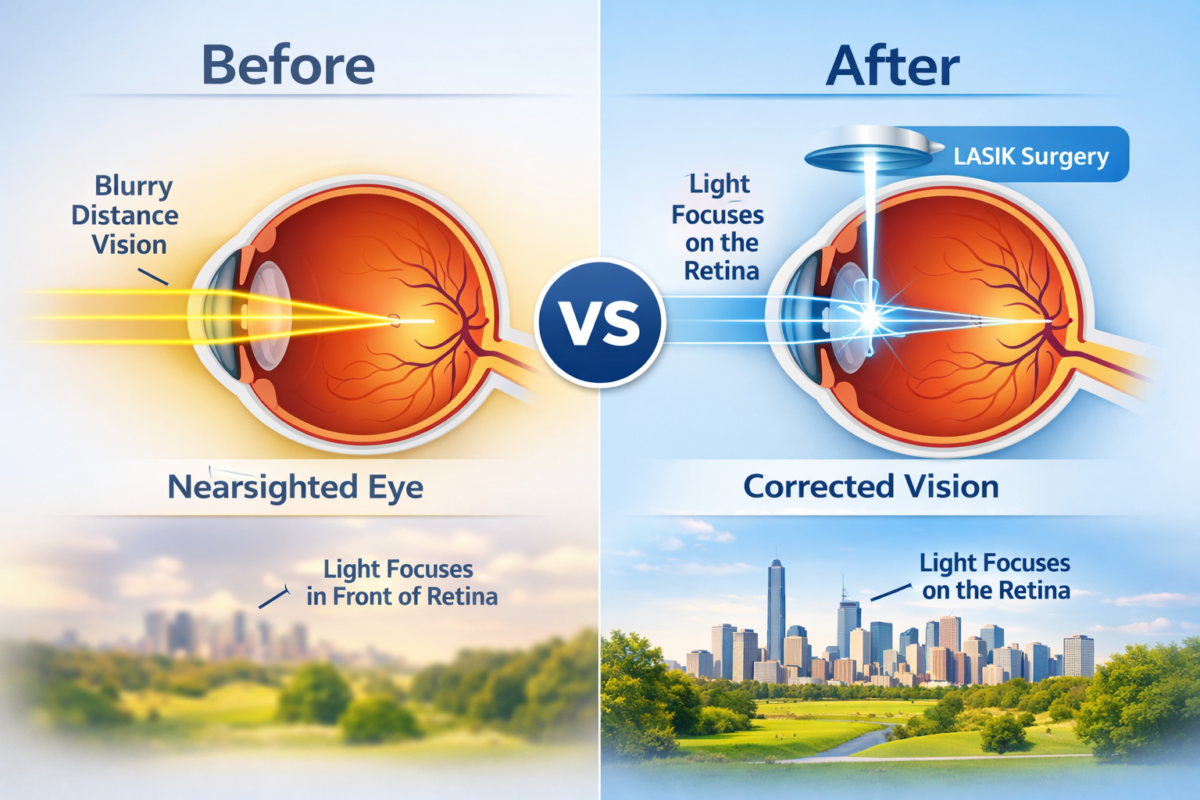
Myopia (nearsightedness) occurs when the eyeball grows too long (axial elongation) or the cornea becomes too curved. This causes light to focus in front of the retina instead of directly on it, making distant objects appear blurry.
The primary causes identified by 2025 research include:
- Genetics: Having one or both parents with myopia significantly increases risk.
- Lack of Outdoor Time: Insufficient exposure to natural sunlight (specifically high-intensity light) disrupts dopamine release, which is needed to stop the eye from elongating.
- Excessive Near Work: Prolonged focus on close objects (reading, smartphones, tablets) creates “peripheral hyperopic defocus,” signaling the eye to grow longer.
- Visual Environment: Poor lighting and posture during study or work.

The Mechanics of Myopia: What’s Happening Inside the Eye?
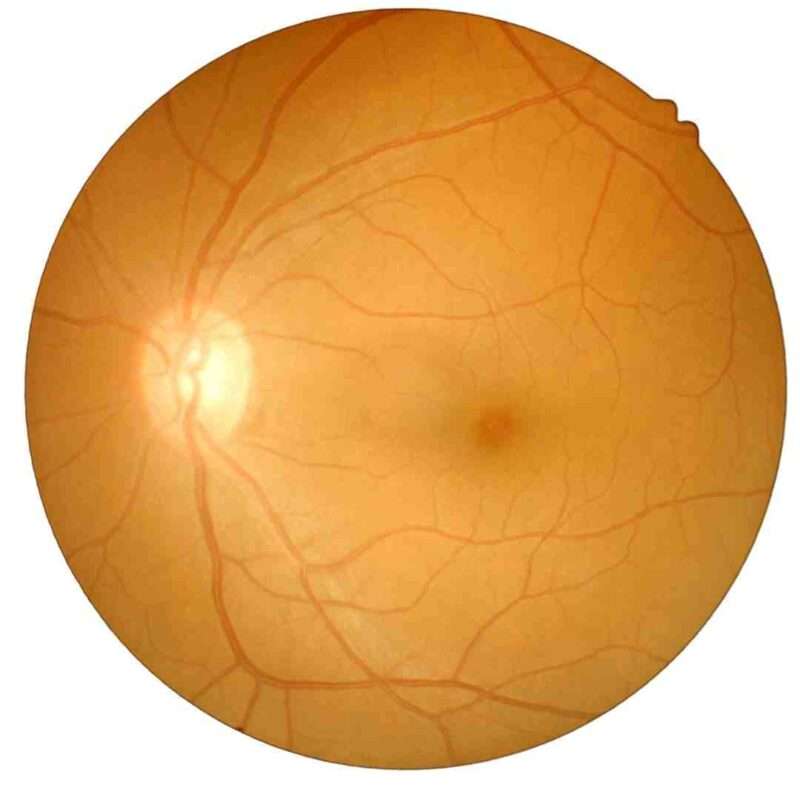
To understand the cause, we must first look at the anatomy. In a perfectly shaped eye (emmetropia), light enters through the cornea and lens and focuses precisely on the retina—the light-sensitive layer at the back of the eye.
In a myopic eye, the mechanics fail in one of two ways:
- Axial Myopia: The eyeball is physically too long from front to back.
- Refractive Myopia: The cornea or lens is too powerful (too curved).
The result? The focal point lands in front of the retina. By the time the light actually hits the retina, it has spread out again, creating a blurry circle.
Why is the eyeball growing?
This is the “million-dollar question” researchers have been answering. The eye naturally grows during childhood, a process called emmetropization. Ideally, it stops growing once vision is perfect. In myopia, this “stop signal” fails, and the eye continues to elongate—sometimes well into early adulthood.
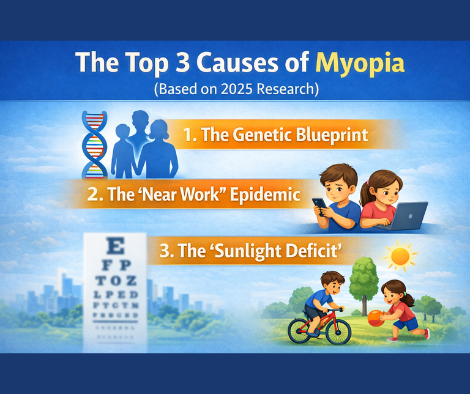
The Top 3 Causes of Myopia (Based on 2025 Research)
1. The Genetic Blueprint
For decades, we thought myopia was entirely genetic. If your parents wore thick glasses, you likely would too.
- Risk Factor: If one parent is myopic, a child’s risk doubles. If both parents are myopic, the risk increases by 3x to 5x.
- The Nuance: Genetics loads the gun, but the environment pulls the trigger. Recent studies show that even children with a genetic predisposition can delay or avoid myopia if they spend enough time outdoors.
2. The “Near Work” Epidemic
This is where modern life takes the blame. “Near work” refers to any visual activity done at a close working distance—reading, writing, and increasingly, screen time.
- The Peripheral Defocus Theory: When you focus intensely on a phone screen 20 cm from your face, the central image is clear, but the image in your peripheral (side) vision focuses behind the retina. The eye detects this blur and interprets it as a signal to “grow” backward to catch the image. This growth leads to permanent elongation.
- Digital Strain: It’s not just the content on the screen; it’s the distance. Holding devices too close creates extreme demand on the eye’s focusing muscles (accommodation).
3. The “Sunlight Deficit” (The Most Critical Finding)
Perhaps the most significant breakthrough in recent years is the link between outdoor time and eye health.
- The Dopamine Connection: Sunlight is significantly brighter than indoor lighting (even bright office lights are dim compared to a cloudy day outside). Bright light triggers the retina to release dopamine.
- Why Dopamine Matters: Dopamine acts as a chemical “brake” on eye growth. Without enough dopamine (due to staying indoors), the eye loses this braking mechanism and grows too long.
- 2025 Recommendation: Current guidelines suggest children need at least 2 hours of outdoor activity daily to protect against myopia onset.
Myopia is More Than Just Glasses: The “Disease” Concept
For a long time, people viewed nearsightedness as a minor inconvenience fixed by a trip to the optical shop. However, the medical community now classifies high myopia (usually defined as -6.00 diopters or higher) as a potential pathway to serious ocular disease.
As the eyeball stretches, the internal structures—the retina and choroid—are stretched thin, like an overinflated balloon. This thinning increases the risk of:
- Retinal Detachment: The retina peels away from the back of the eye.
- Myopic Maculopathy: Degeneration of the central part of the retina.
- Glaucoma: Increased pressure damage to the optic nerve.
- Cataracts: Developing clouding of the lens at a younger age.
Note: This is why “myopia control” is vital for children. Keeping a child’s prescription low (e.g., -2.00 instead of -6.00) drastically reduces their lifetime risk of blindness.
Modern Prevention & Management Strategies
If you or your child has been diagnosed with myopia, the goal is no longer just “correction” (glasses); it is control (slowing the progression).
1. Lifestyle Adjustments (The First Line of Defense)
- The 20-20-20 Rule: Every 20 minutes, look at something 20 feet away for 20 seconds. This relaxes the focusing muscle.
- Distance Matters: Keep reading material (and phones!) at least an elbow’s distance away—roughly 30-40 cm.
- Green Time, Not Screen Time: Prioritize outdoor play.
2. Clinical Interventions
- Low-Dose Atropine Drops: Special eye drops (0.01% to 0.05%) used at night can significantly slow eye growth in children without affecting near vision.
- Orthokeratology (Ortho-K): Rigid contact lenses worn only while sleeping. They gently reshape the cornea overnight so you can see clearly during the day without glasses.
- Myopia Control Spectacles: These aren’t standard glasses. They use specialized “defocus” technology (like DIMS or HALT technology) to correct vision while simultaneously sending a “stop growth” signal to the eye.
Advanced Eye Care in Bangalore: Why Choose Vijaya Nethralaya?
Understanding the cause of myopia is the first step; getting expert care is the second. If you are looking for a super specialty eye hospital that combines decades of experience with cutting-edge myopia control technology, Vijaya Nethralaya is your trusted partner.
Located conveniently in Nagarbhavi, just minutes away from Vijayanagar, we are a hub for comprehensive vision care.
Why Patients Trust Us:
- Expert Leadership: Our team is led by Dr. Appaji Gowda, a veteran with over 35 years of experience, and Dr. Sushruth Appaji Gowda, our Chief Cataract & Refractive Surgeon, known for his precision and patient-centric approach.
- Comprehensive Myopia Clinic: We don’t just prescribe glasses. We offer a full suite of myopia control therapies, including Ortho-K, atropine therapy, and advanced counseling for parents.
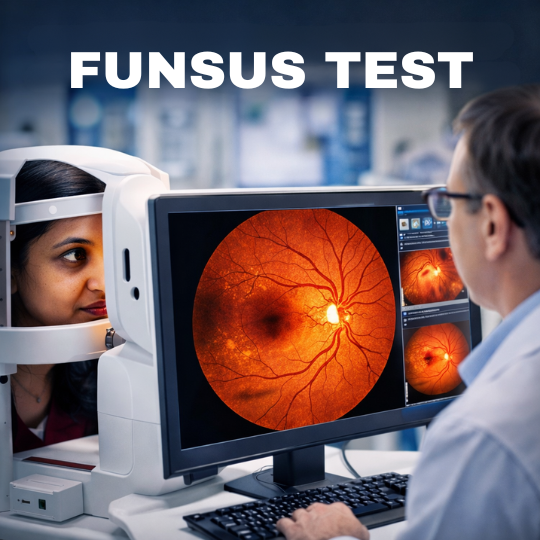
- State-of-the-Art Technology: From detailed axial length measurement to wide-field retinal imaging, we detect early signs of myopic damage that standard eye exams might miss.
Location Note: We are easily accessible for residents of Vijayanagar. (Please note: Our Hanumanthanagar branch is now closed; all specialized services are centralized at our Nagarbhavi Main Branch for your convenience.)
H2: Conclusion: Protect Your Vision Today
Myopia is complex, caused by a “perfect storm” of genetics, urbanization, and our digital habits. While we cannot change our DNA, we can change our environment. By balancing screen time with sunshine and seeking early intervention, we can protect our sight and the sight of future generations.
H2: Frequently Asked Questions (FAQ)
Q: Can eye exercises cure myopia naturally? A: No, scientific evidence does not support the claim that eye exercises (like “eye yoga”) can reverse the physical elongation of the eyeball. However, they can help reduce digital eye strain.
Q: Does wearing glasses make eyes worse? A: This is a common myth. Not wearing glasses actually makes myopia progress faster because the eye strains to see, increasing the blur signal that stimulates growth.
Q: At what age does myopia usually stop getting worse? A: Typically, myopia stabilizes around age 20-21 when the body stops growing. However, with intense computer work, “adult-onset myopia,” or progression, can occur in your mid-20s.
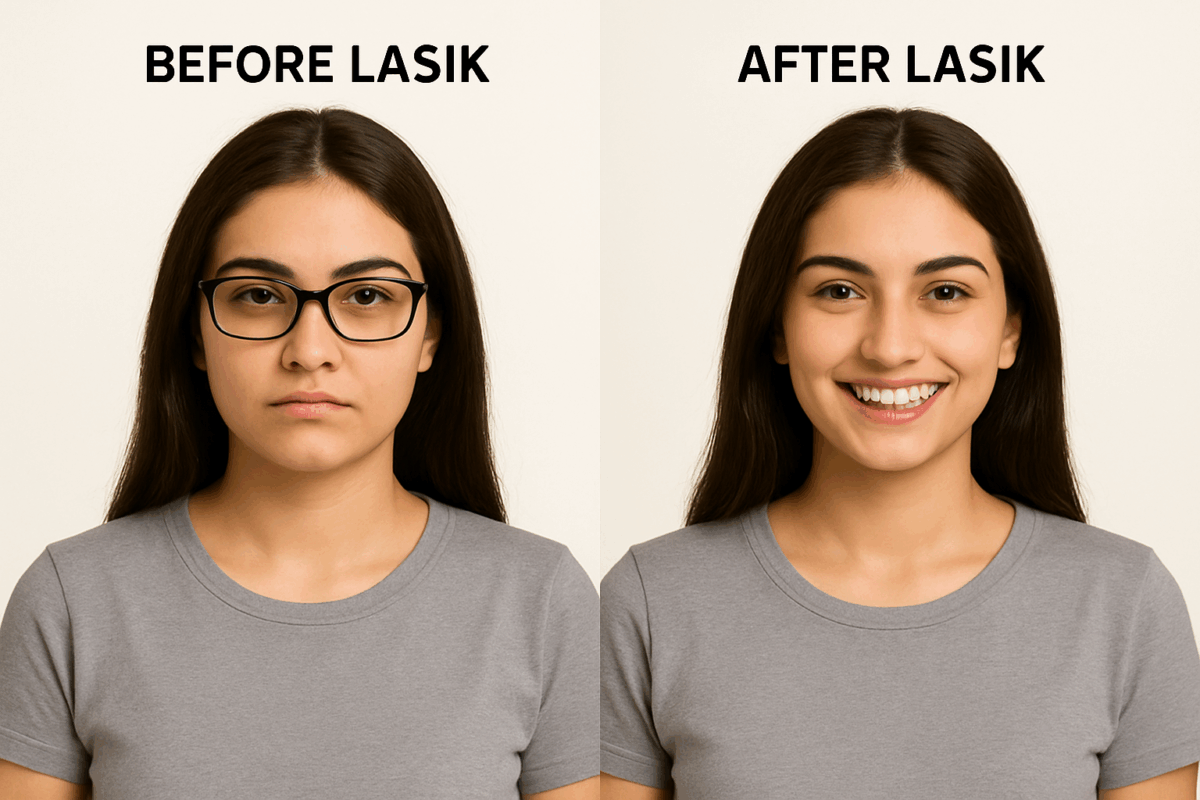
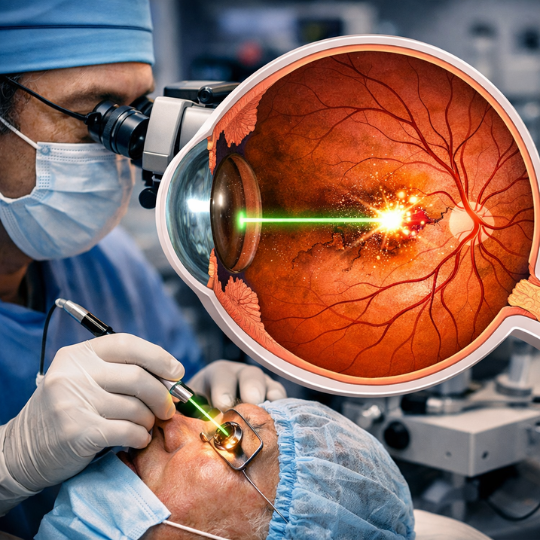
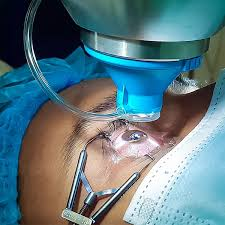
Q: Is LASIK a cure for myopia? A: LASIK corrects the refractive error (the focus), so you don’t need glasses, but it does not shorten the eyeball. The underlying risks of high myopia (like retinal issues) remain, which is why presurgical retinal checkups are crucial.
Q: How much screen time is safe for kids? A: The World Health Organization (WHO) recommends:
- 0-2 years: Zero screen time (except video chatting).
- 2-5 years: Less than 1 hour per day.
- 5+ years: Consistent limits, balanced with at least 2 hours of outdoor activity.