
Introduction:
What Is Lazy Eye (Amblyopia)? Is lazy eye treatable?
Is lazy eye treatable? Lazy eye, medically known as amblyopia, is more than just a quirky name for an eye problem. It is a vision development disorder. One eye does not reach normal visual acuity. This is true even with glasses or contact lenses. In simple words, one eye becomes stronger while the other stays weaker. The brain begins to favor the stronger eye and gradually ignores signals from the weaker one. Over time, the weaker eye may lose its ability to see clearly.
Think of it like this: imagine you’re always using your dominant hand for everything—writing, lifting, opening doors. The other hand would eventually become less coordinated and weaker. The same concept applies to your eyes. If the brain keeps relying on one eye, the other one doesn’t get enough “practice,” and its visual pathway doesn’t develop properly.
Lazy eye usually begins in early childhood, typically before the age of seven. This period is crucial because a child’s brain is still developing visual connections. If amblyopia isn’t detected and treated during these early years, it can lead to long-term vision problems.
Here’s the key point: lazy eye is not caused by laziness. The eye itself may look perfectly normal. The issue lies in the communication between the brain and the eye. That’s what makes early diagnosis so important.
Understanding amblyopia is the first step toward answering the big question: is lazy eye treatable? The short answer is yes—but timing, consistency, and proper treatment make all the difference.
Common Signs of Lazy Eye
- One eye drifts inward or outward
- Blurred or reduced vision in one eye
- Difficulty with depth perception
- Squinting or tilting head
If left untreated, lazy eye can lead to permanent vision loss in the affected eye because the brain suppresses its input permanently.

Definition and Medical Explanation:
Amblyopia is a neurodevelopmental disorder of vision. That might sound complicated, but let’s break it down. “Neuro” refers to the brain, and “developmental” refers to growth. Amblyopia is a condition where the brain does not develop the ability to process images from one eye properly.
Normally, both eyes send clear, focused images to the brain. The brain then combines these two images into a single, three-dimensional picture. However, in amblyopia, one eye sends a blurry or misaligned image. Instead of trying to fix the confusion, the brain simply suppresses—or ignores—the image from the weaker eye.
Over time, this suppression becomes automatic. The brain essentially “turns off” the weaker eye to avoid double vision or confusion. When this happens during childhood, the neural pathways responsible for vision in that eye fail to develop fully.
There are three main types of amblyopia:
- Strabismic amblyopia—caused by eye misalignment.
- Refractive amblyopia—caused by unequal refractive errors between eyes.
- Deprivation amblyopia—caused by something blocking vision, such as a cataract.
What’s interesting is that amblyopia affects about 2–3% of children worldwide. That makes it one of the most common vision disorders in kids. Yet many parents don’t notice it right away because children may not complain. After all, if one eye sees clearly, the child assumes that’s normal.
The medical community emphasizes early screening because untreated amblyopia can lead to permanent vision loss in the affected eye. But here’s the encouraging part: with proper intervention, the brain can be retrained. The visual system is surprisingly adaptable, especially in young children.
So yes, lazy eye is a brain-eye communication issue—not just an eye problem. And understanding that makes treatment strategies much clearer.
How Lazy Eye Develops in Early Childhood:
The first few years of life are like a construction phase for the brain. Neural connections are forming rapidly, especially those related to sight. During this “critical period,” the brain learns how to interpret visual information from both eyes.
Now imagine one eye sends a blurry image because of nearsightedness, farsightedness, or astigmatism. Or perhaps the eyes are misaligned, pointing in different directions. The brain receives two different images that don’t match. It doesn’t like confusion. So what does it do? It picks the clearer image and ignores the other one.
This process may start as early as infancy. If the issue isn’t corrected, the brain continues to favor the stronger eye. The neural pathways for the weaker eye don’t develop properly. Eventually, the weaker eye’s visual acuity decreases, even if the original problem is later corrected.
Children are especially vulnerable because they don’t realize something is wrong. If one eye sees clearly, they assume everything is fine. Unlike adults, they don’t have a reference point for comparison.
Several risk factors increase the chances of developing amblyopia:
- Premature birth
- Low birth weight
- Family history of amblyopia
- Developmental delays
- Significant refractive errors
The earlier amblyopia develops, the more severe it can become if left untreated. Here’s the hopeful part: children’s brains can change a lot. This means that treatment during early childhood can work very well.
In many cases, early intervention can restore near-normal vision. That’s why pediatric eye exams are so important—even if there are no obvious symptoms.
The story of lazy eye development is really a story about timing. Catch it early, and the outcome can be life-changing.
Difference Between Lazy Eye and Strabismus:
People often confuse lazy eye with crossed eyes, but they’re not exactly the same thing. While they’re related, they are distinct conditions.
Strabismus refers to misalignment of the eyes. One eye may turn inward, outward, upward, or downward. This misalignment can be constant or intermittent. When the eyes don’t align properly, the brain receives two different images. To avoid double vision, it may start ignoring one eye.
That’s where amblyopia can come in.
Lazy eye (amblyopia) is the result of the brain suppressing one eye’s input. Strabismus is one possible cause of amblyopia, but not the only one.
Let’s simplify it:
| Condition | What It Is | What It Affects |
|---|---|---|
| Strabismus | Eye misalignment | Eye muscles and positioning |
| Amblyopia | Reduced vision in one eye | Brain-eye connection |
A child can have strabismus without amblyopia if both eyes still develop good vision. Likewise, a child can have amblyopia without visible misalignment, especially in cases caused by unequal refractive errors.
This distinction matters because treatment approaches differ. Strabismus may require muscle surgery to align the eyes, while amblyopia treatment focuses on strengthening the weaker eye.
Understanding this difference helps answer the main question more clearly: treating strabismus alone doesn’t automatically fix lazy eye. Both issues must be addressed separately if they coexist.
Is Lazy Eye Treatable at Any Age?
Yes—but timing matters.
- Children: Best outcomes occur when treatment starts early, ideally before age 7–8.
- Adults: Traditional beliefs suggested limited success, but recent research shows improvements are possible even in adulthood with proper therapy.
Key takeaway: Amblyopia can be treated at almost any age, but early treatment yields the most dramatic results.
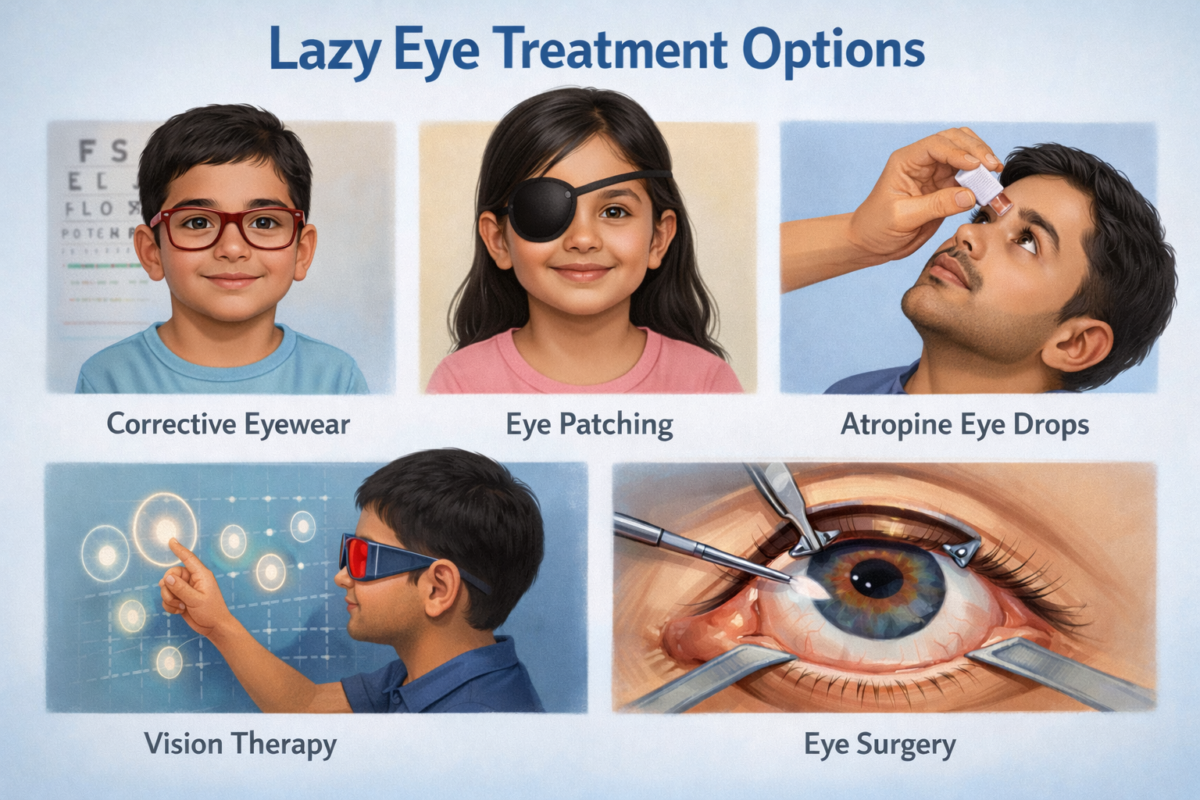
Proven Treatments for Lazy Eye
1. Corrective Eyewear
Prescription glasses or contact lenses help clear vision and reduce the difference in focus between the eyes—often the first treatment step.
2. Patching (Occlusion Therapy)
Covering the stronger eye forces the brain to use the weaker one. This strengthens neural connections and improves vision.
✔ Most effective in young children
✔ Success depends on consistent use
3. Atropine Eye Drops
Used as an alternative to patching. Drops blur the strong eye, encouraging use of the weaker eye.
4. Vision Therapy (Orthoptics)
A customized program of supervised eye exercises aimed at improving:
- Eye coordination
- Focus control
- Depth perception
This is often the most effective route for older children and adults.
5. Surgery
Used when strabismus is the cause. Surgery corrects the eye alignment, improving the effectiveness of other therapies.
How Effective Are These Treatments?
| Treatment Type | Best Age Group | Effectiveness |
|---|---|---|
| Eyeglasses | All ages | Moderate |
| Patching | 3–7 years | High |
| Atropine Drops | 3–8 years | Moderate-High |
| Vision Therapy | Children & Adults | Moderate-High |
| Eye Muscle Surgery | Children & Adults | High when combined with therapy |
Can Adults Improve Their Vision?
Yes—adult lazy eye treatment is no longer considered futile. Advanced therapies like vision training, digital software programs, and binocular vision therapy have helped adults improve.
Although adults may take longer to respond than children, consistent therapy can still lead to measurable gains.
Author Details:
Dr. Sushruth Appajigowda holds a prominent position as a cornea, cataract, glaucoma, and LASIK surgeon in Bangalore. He serves as the chief cataract and refractive surgeon at Vijaya Nethralaya Eye Hospital, Nagarbhavi, Bangalore. Renowned as one of the finest LASIK surgeons nationwide, he brings with him over 12+ years of experience across multiple LASIK platforms, including ZEISS, ALCON, SCHWIND, AMO, and Bausch and Lomb. Having successfully conducted over 5000 LASIK procedures, Dr. Sushruth holds the title of a Certified Refractive Surgeon and a Fellow of the All India Collegium of Ophthalmology. Furthermore, he stands as a distinguished speaker at various national and international forums, using his expertise to guide you in selecting the most suitable procedure based on your health requirements.