

Introduction: Why Myopia is the “Silent Epidemic” of Our Time
If you’ve noticed that more children—and adults—are squinting to see the whiteboard or road signs, you aren’t imagining things. We are in the midst of a global myopia boom. By 2050, it is estimated that 50% of the world’s population will be myopic.
But here is the critical shift in thinking for 2025: Myopia is no longer viewed simply as a refractive error to be “fixed” with stronger glasses every year. It is now recognized as a medical condition involving axial elongation—the physical lengthening of the eyeball. This stretching thins the retina and increases the long-term risk of serious conditions like retinal detachment, myopic maculopathy, and glaucoma.
The good news? We have moved from an era of correction to an era of control and prevention. Whether you are a parent worried about your child’s prescription or an adult battling digital eye strain, this guide breaks down the latest evidence-based protocols to protect your vision.
The Mechanism: What Actually Causes Myopia?
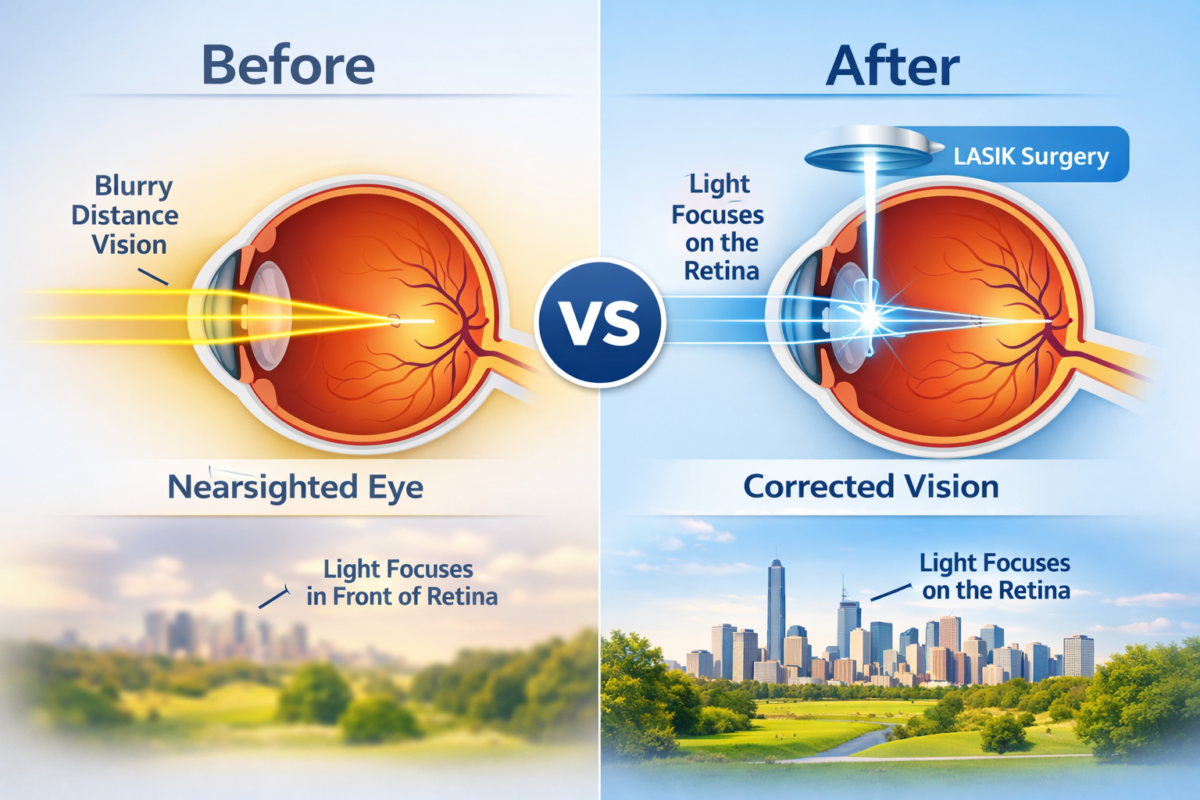
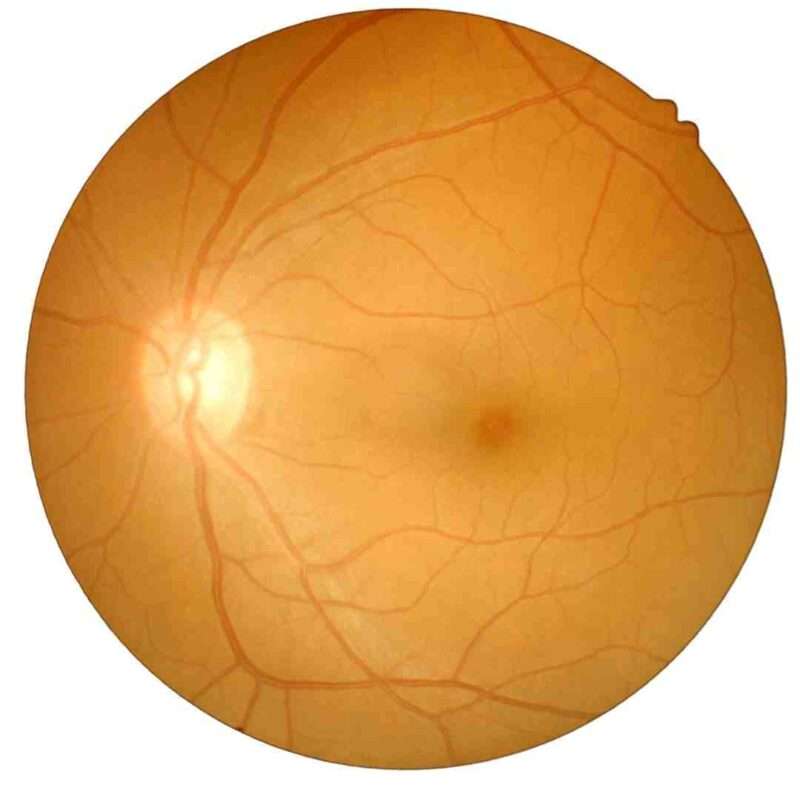
To prevent it, you must understand it. In a perfectly shaped eye, light focuses precisely on the retina. In a myopic eye, the eyeball grows too long (axial length increases). This causes light to focus in front of the retina, making distant objects appear blurry.

The “Blur” Signal
Research in 2024 and 2025 has solidified the theory of peripheral hyperopic defocus. When you wear standard glasses, they correct your central vision perfectly but may cause light to focus behind the retina in your peripheral vision. Your eye interprets this as a signal to “grow” to catch the light, worsening the myopia. This is why standard glasses often fail to stop the progression—and why new “myopia control” methods are so vital.
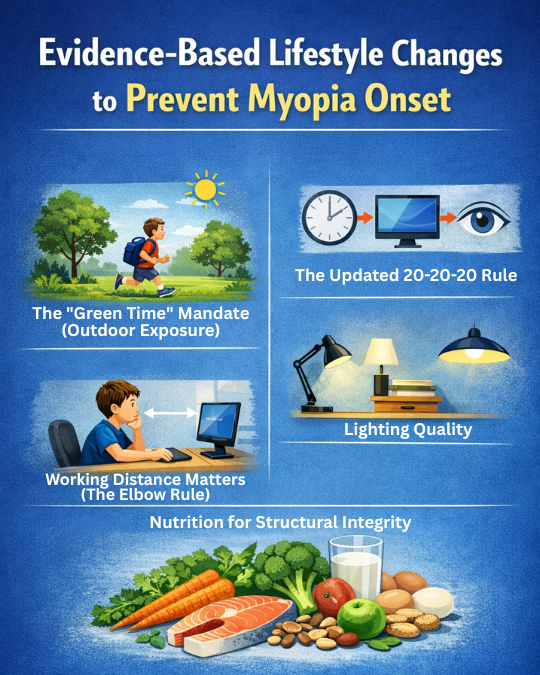
5 Evidence-Based Lifestyle Changes to Prevent Myopia Onset
Before we look at medical treatments, we must address the “experience” factor—our daily habits. These are the first line of defense, especially for delaying the onset of myopia in young children.
1. The “Green Time” Mandate (Outdoor Exposure)
If there is one “magic pill” for preventing myopia, it is sunlight.
- The Science: Sunlight stimulates the release of dopamine in the retina, a neurotransmitter that inhibits the eye from growing too long.
- The Protocol: The International Myopia Institute (IMI) recommends 80 to 120 minutes of outdoor time per day.
- Pro Tip: It’s not about activity; it’s about light intensity. Even sitting under a tree reading a book counts. Indoor lighting typically offers 500 lux, whereas a cloudy day outside offers 10,000+ lux.
2. The Updated 20-20-20 Rule
We all know the rule, but few follow it correctly.
- The Rule: Every 20 minutes, look at something 20 feet away for 20 seconds.
- Why it works: It relaxes the ciliary muscles that contract during near work (accommodation).
- The 2025 Update: Recent studies suggest you should “blink fully” during this break. Partial blinking (common when staring at screens) leads to dry eyes, which exacerbates visual fatigue.
3. Working Distance Matters (The Elbow Rule)
Holding a phone or book too close creates intense demand on the eye’s focusing system.
- The “Elbow” Test: Encourage children (and yourself) to keep reading material at a distance equal to the length of their forearm (elbow to knuckles).
- Screen Ergonomics: Computer monitors should be an arm’s length away, with the top of the screen at or slightly below eye level.
4. Lighting Quality
Dim light forces the eyes to strain to maintain focus and contrast.
- Recommendation: Ensure the room is evenly lit. Avoid using a bright screen in a pitch-black room, as the high contrast causes significant glare and strain. Use “bias lighting” (a soft light behind your monitor) to reduce contrast stress.
5. Nutrition for Structural Integrity
While carrots won’t reverse a prescription, a diet rich in Vitamin A, C, E, and Omega-3 fatty acids supports the sclera (the white outer coat of the eye). A stronger sclera may be more resistant to stretching.
Advanced Medical Interventions for Myopia Control
For children whose prescription is already changing (e.g., -0.50 to -1.25 in a year), lifestyle changes alone are insufficient. This is where Myopia Control—a specialized field of ophthalmology—steps in.
1. Low-Dose Atropine Eye Drops
- What it is: A very dilute concentration of atropine (0.01% to 0.05%) used nightly.
- How it works: It acts on receptors in the eye to chemically signal the eye to stop growing.
- 2025 Outlook: The LAMP (Low-Concentration Atropine for Myopia Progression) study has shown that 0.05% is often more effective than 0.01% for certain fast progressors. It is the “gold standard” pharmacological treatment.
2. Orthokeratology (Ortho-K)
- The Concept: You wear special rigid contact lenses while you sleep.
- The Result: The lenses gently reshape the cornea overnight. When you wake up, you remove them and see clearly all day without glasses.
- The Bonus: It creates a specific optical profile on the cornea that slows eye growth. It is fantastic for active kids and swimmers.
3. Next-Gen Spectacle Lenses (DIMS & HAL Technology)
If you don’t want drops or contacts, 2025 has incredible options in glasses.
- DIMS (Defocus Incorporated Multiple Segments): Lenses like the Hoya MiyoSmart.
- HAL (Highly Aspherical Lenslets): Lenses like the Essilor Stellest.
- How they work: These look like normal glasses but have hundreds of tiny “micro-lenses” that create a protective defocus signal for the retina, slowing axial growth by up to 60% compared to standard lenses.
4. Repeated Low-Level Red-Light (RLRL) Therapy
- Emerging Tech: This is a newer therapy involving a device that delivers specific wavelengths of red light to the retina for 3 minutes, twice a day.
- Status: While promising in reducing axial elongation, it is still being rigorously studied for long-term safety. Consult a specialist before buying home devices.
Myopia Prevention by Age Group
Prevention isn’t one-size-fits-all. Here is how to tailor your approach:
Toddlers & Preschoolers (0-5 Years)
- Goal: Delay Onset.
- Strategy: Zero unnecessary screen time. Maximize outdoor play.
- Red Flag: If a parent is myopic, the child is at higher risk. Schedule their first comprehensive eye exam at age 3, not just a school vision screening.
School-Aged Children (6-16 Years)
- Goal: Slow Progression.
- Strategy: This is the “danger zone” for axial growth.
- Strict enforcement of the 2-hour outdoor rule.
- Use of Myopia Control glasses/drops if prescription changes.
- Digital breaks are non-negotiable.
Young Adults & Professionals (17+ Years)
- Goal: Reduce Strain & Stabilize.
- Strategy: While the eye stops growing for most by age 21, “Adult Onset Myopia” can occur due to intense near-work (law students, coders).
- Focus on ergonomics.
- Use “anti-fatigue” lenses that have a slight boost for reading to relax eye muscles.
- Manage Dry Eye Disease, which mimics the symptoms of blur and strain.
The “Blue Light” Myth vs. Reality
“Do I need blue light glasses to prevent myopia?” This is one of the most common questions we hear.
- The Reality: There is currently no scientific evidence that blue light from screens causes myopia or permanently damages the retina. The sun is the largest source of blue light we encounter.
- The Nuance: Blue light does affect your circadian rhythm (sleep cycle). Poor sleep is linked to poorer general health and eye development.
- The Verdict: Wear blue light blockers if they help you sleep better or feel more comfortable, but do not rely on them to stop your prescription from increasing. Distance management is far more effective than blue light filtering.
Conclusion: The Next Step for Your Vision
Preventing myopia in 2025 is an active process. It requires a partnership between healthy lifestyle choices and proactive medical care. Whether you are protecting your child’s future vision or preserving your own, the “wait and see” approach is outdated.
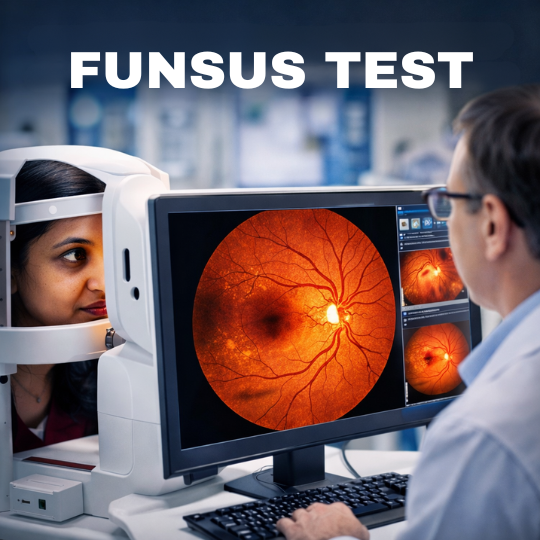
If you are noticing frequent headaches, squinting, or a prescription that changes every year, you need a Comprehensive Myopia Assessment. This goes beyond reading letters on a wall chart; it involves measuring the axial length of the eye and assessing binocular vision health.
H2: FAQs (Optimized for Voice Search)
Q: Can myopia be reversed naturally? A: No. Once the eyeball has elongated, it cannot “shrink” back. You cannot reverse physiological myopia with eye exercises or yoga. However, you can prevent it from getting worse (myopia control) and correct the blur with surgery like LASIK once the prescription stabilizes.
Q: Does wearing glasses all the time make your eyes weaker? A: This is a myth. Not wearing your glasses (undercorrection) actually accelerates myopia progression because the eye strains to see, increasing the “blur signal” that tells the eye to grow longer.
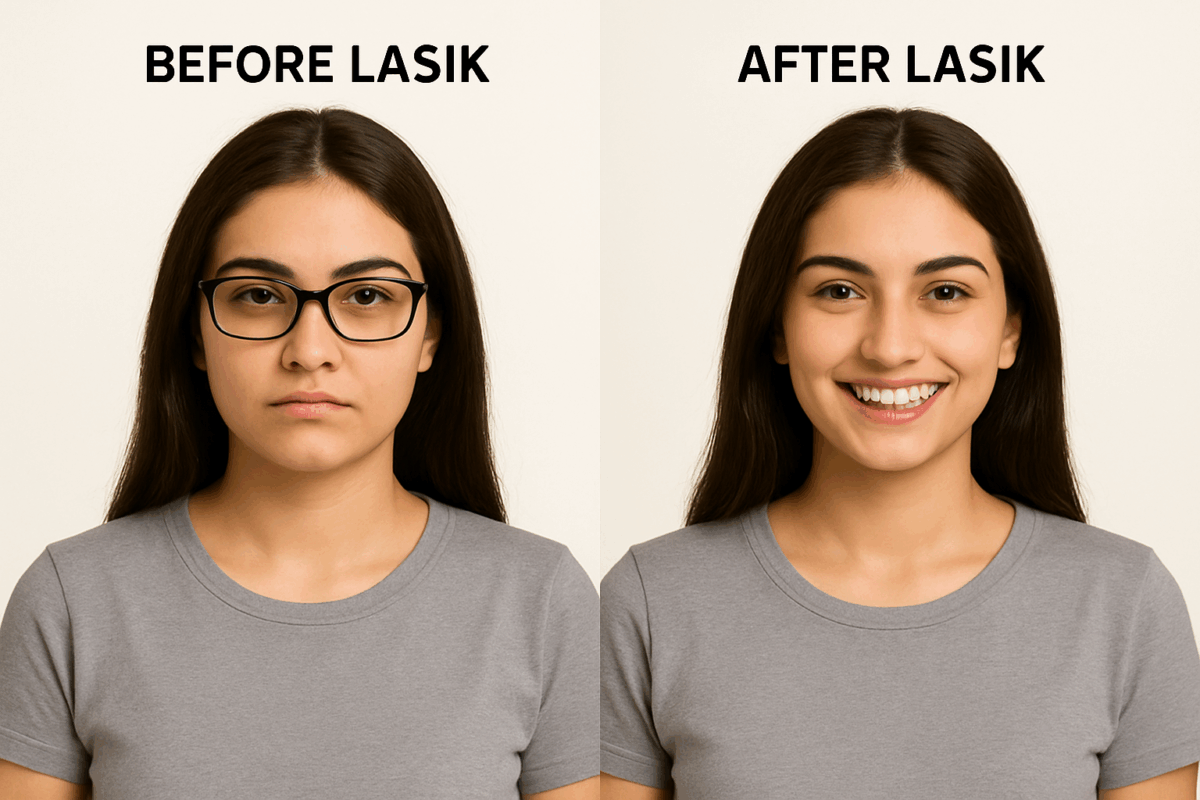
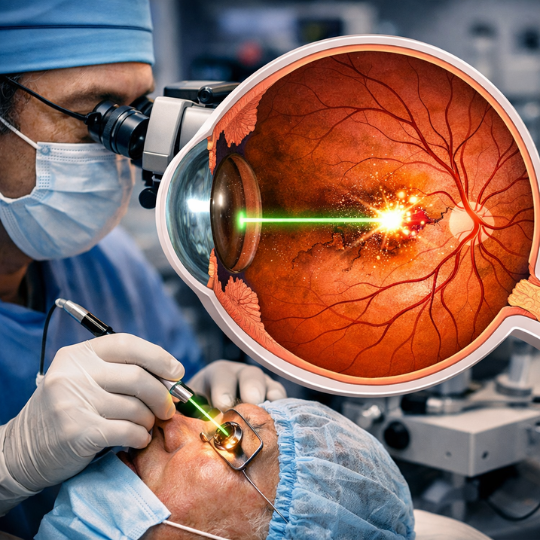
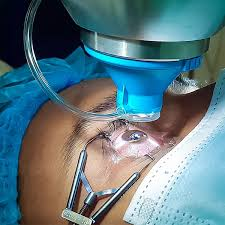
Q: Is LASIK a cure for myopia? A: LASIK is a correction, not a cure. It reshapes the cornea so you don’t need glasses, but your eyeball remains elongated. You still carry the retinal risks associated with high myopia, so annual retina checkups are essential even after perfect LASIK surgery.
Q: What is the best age to start myopia control? A: As soon as myopia is detected. The earlier you intervene, the more “vision capital” you save. Starting at age 8 is better than age 12, but it is never too late to slow progression in a growing child.
Expert Care
For residents of Bangalore, particularly near Vijayanagar, Vijaya Nethralaya Super Speciality Eye Hospital is a leader in this field.
Led by experienced specialists like Dr. Sushruth and Dr. Appaji Gowda, the hospital is equipped with state-of-the-art diagnostic tools to detect pre-myopia signals early. They offer a full spectrum of solutions—from pediatric myopia control (Atropine, Ortho-K) to advanced refractive surgeries (LASIK) for adults.
Why choose Vijaya Nethralaya?
- Holistic Approach: They don’t just prescribe glasses; they treat the underlying progression.
- Advanced Tech: Equipped for precise Axial Length measurement (the new vital sign for eyes).
- Patient-Centric: Known for their compassionate staff and clear communication (4.8+ star ratings).
📍 Visit Them: Vijaya Nethralaya Super Speciality Eye Hospital Near Vijayanagar, Bangalore.