
Can Myopia Be Cured? In the strict medical sense, myopia (nearsightedness) is a physiological elongation of the eye that cannot be “cured” like an infection. However, it can be corrected to 20/20 vision through surgery (LASIK, SMILE), temporarily reversed via Ortho-K lenses, or managed to stop progression in children using atropine drops and special optics.
- Best for Permanent Correction: LASIK, SMILE, ICL.
- Best for Kids (Control): Low-dose Atropine, MiSight Lenses, Ortho-K.
- Natural Methods: Effective for prevention (outdoor time), not for reversing established refractive error.
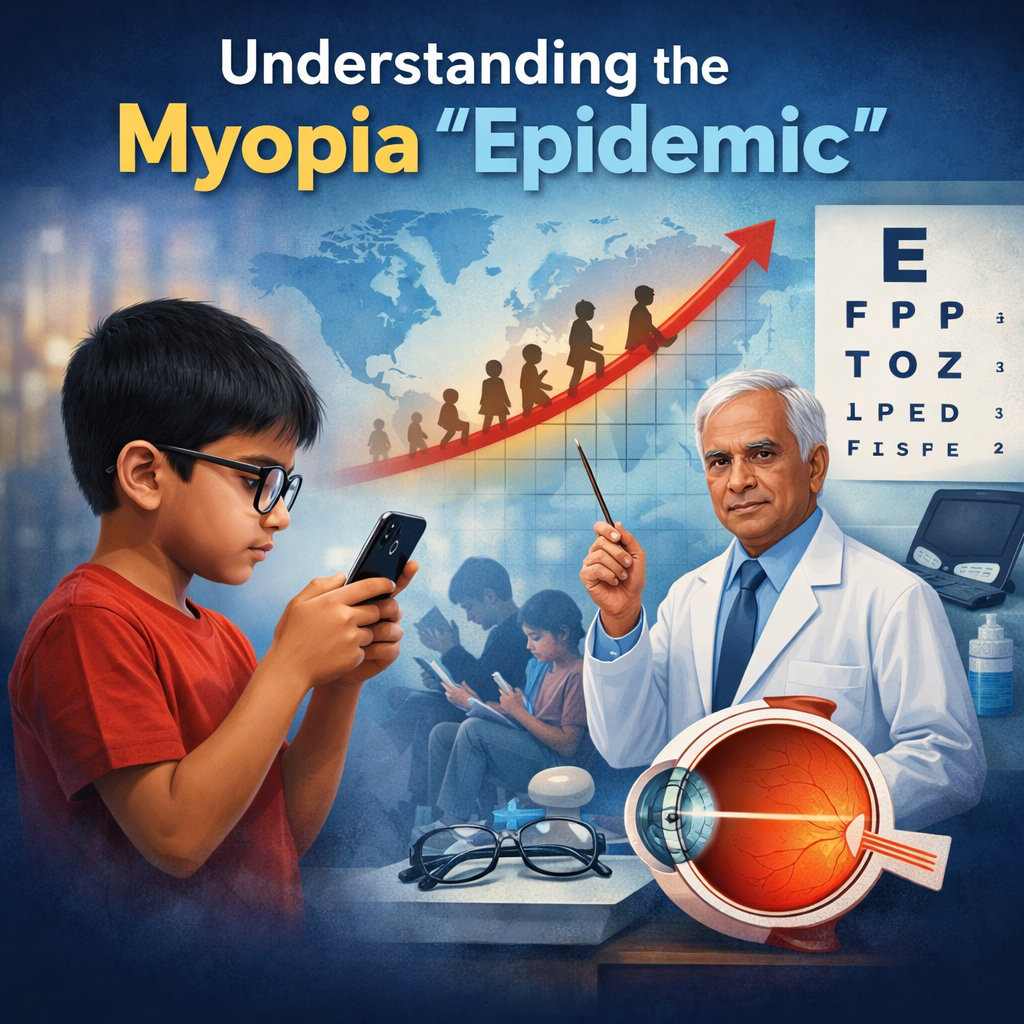
Understanding the Myopia “Epidemic”
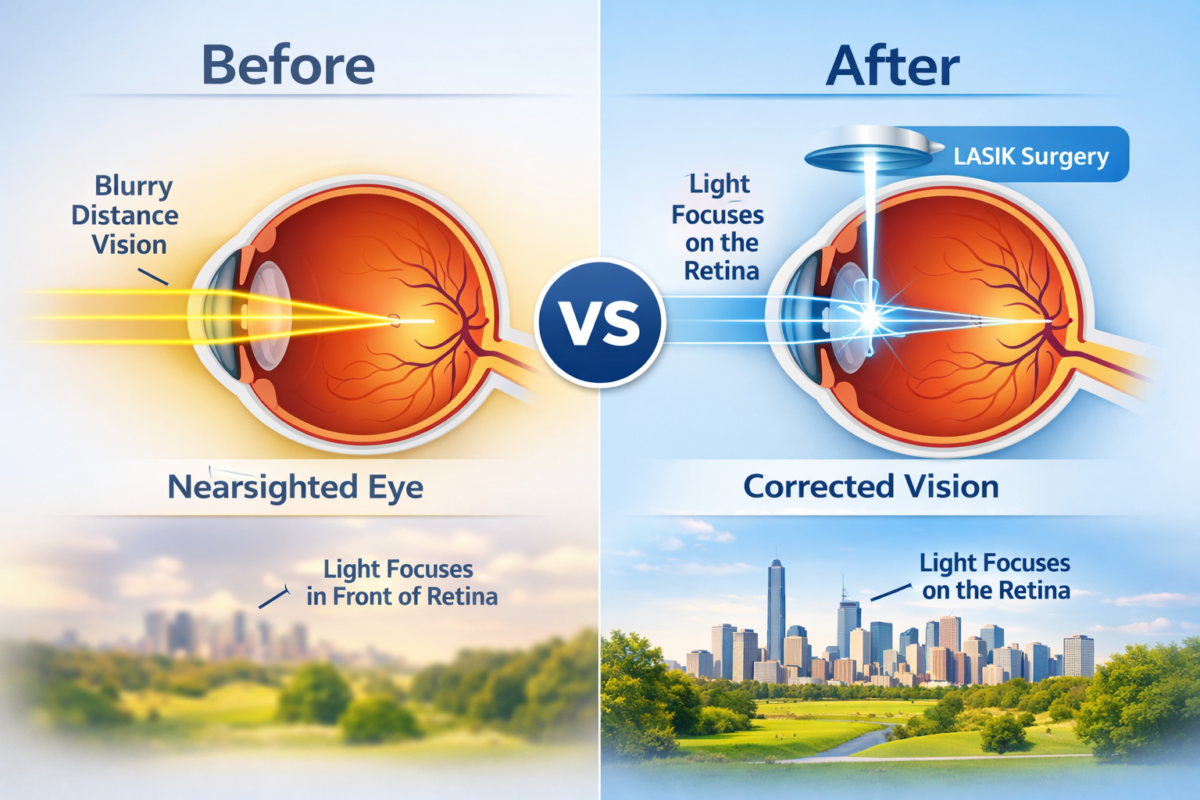
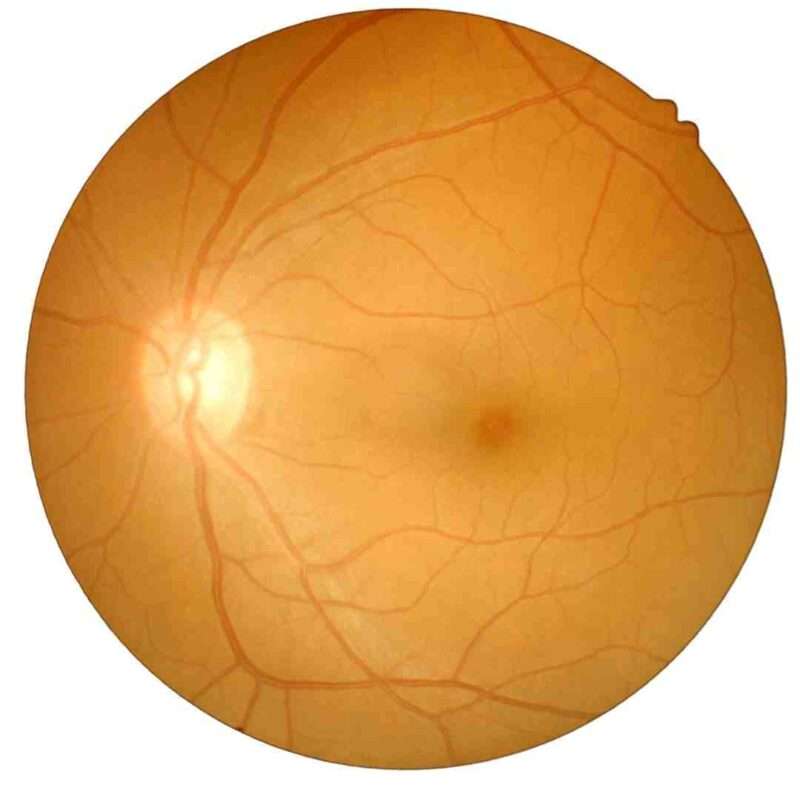
Myopia is not just “bad glasses.” It is a mismatch between the optical power of the eye and its length. When the eyeball grows too long (axial elongation), light focuses in front of the retina rather than on it.
Why is everyone getting it?
- Genetics: If both parents are myopic, the risk increases significantly.
- Environmental Load: The modern “near-work” lifestyle (screens, studying) combined with a lack of sunlight.
- 2025 Context: Post-pandemic data shows a spike in “quarantine myopia” among children, making early intervention more critical than ever.

The Difference Between “Curing,” “Correcting,” and “Controlling”
To understand your options, you must distinguish between these three medical terms.
Correction (The “Functional” Cure)
This restores 20/20 vision so you don’t need glasses. The underlying eye shape remains elongated, but the light path is fixed.
- Methods: Glasses, Contacts, and Refractive Surgery.
Control (The Progressive Halt)
This is vital for children. It stops a prescription of -1.00 from becoming -6.00.
- Methods: Atropine, specialized soft lenses, and red light therapy.
Reversal (The Myth vs. Reality)
- Myth: Eye yoga or vitamins will shrink the eyeball back to normal.
- Reality: Ortho-K lenses can temporarily reshape the cornea for clear vision without glasses, but the effect is reversible if you stop wearing them.
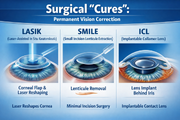
Surgical “Cures”: Permanent Vision Correction
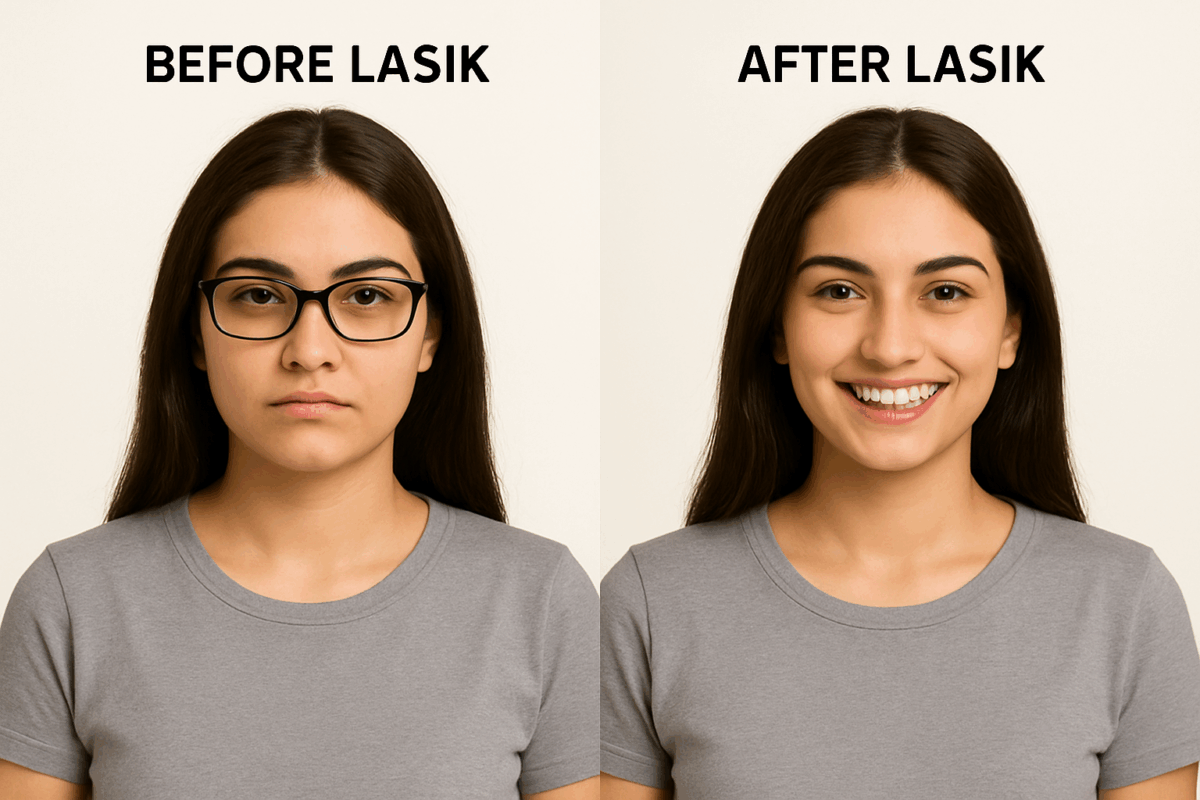
For adults (usually 18-21+) with stable prescriptions, surgery is the closest thing to a permanent cure for the symptoms of myopia.
LASIK (Laser-Assisted In Situ Keratomileusis)
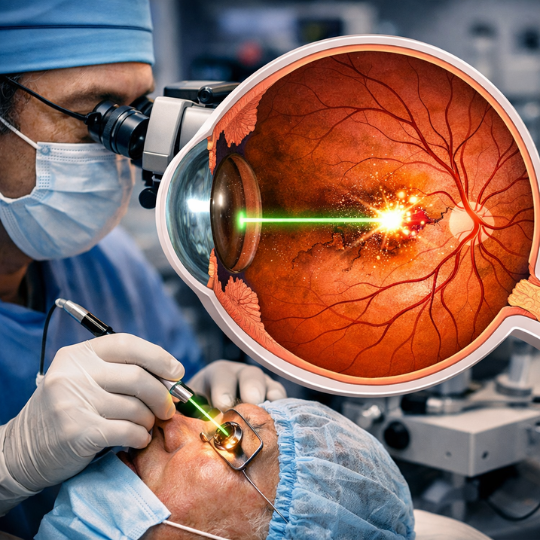
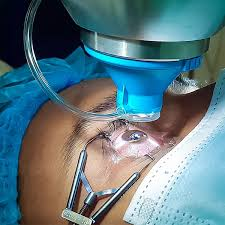
The most common procedure. A laser creates a flap in the cornea, and underlying tissue is reshaped.
- Recovery: Rapid (24-48 hours).
- Best For: Low to moderate myopia.
SMILE (Small Incision Lenticule Extraction)
The “keyhole surgery.” No flap is created; a laser carves a small disc within the cornea, which is removed through a tiny incision.
- Pros: Less dry eye risk than LASIK; mechanically stronger cornea.
- 2025 Status: Gaining massive popularity for active individuals.
ICL (Implantable Collamer Lens)
Think of this as a permanent contact lens implanted inside the eye.
- Best For: High myopia (above -8.00D) or thin corneas not suitable for lasers.
- Reversibility: Unlike LASIK, ICL can be removed.
Non-Surgical Methods: Myopia Control (For Kids & Teens)
If you are a parent reading this, time is of the essence. The goal is to keep the number low to prevent future retinal detachment or glaucoma.
| Treatment | How It Works | Effectiveness | Best For |
| Ortho-K (Orthokeratology) | Hard lenses worn while sleeping reshape the cornea. Perfect vision during the day without glasses. | High | Active kids; swimmers. |
| Low-Dose Atropine | Eye drops (0.01% – 0.05%) relax the focusing mechanism and slow eye growth. | Moderate to High | Kids who can’t wear contacts. |
| MiSight/Stellest Lenses | Soft contacts or glasses with “defocus” rings that trick the eye into stopping growth. | High | Children aged 6-12. |
| Red Light Therapy (RLRL) | New for 2025. Repeated low-level red light therapy boosts blood flow to the choroid. | Emerging/High | Under medical supervision only. |
Deep Dive: Ortho-K (The “Overnight Cure”)
Orthokeratology is often called “braces for the eyes.”
- The Process: You insert rigid gas-permeable lenses at bedtime. While you sleep, the hydraulic pressure from the lens gently flattens the cornea.
- The Result: You wake up, remove the lenses, and see 20/20 all day.
- Is it permanent? No. If you stop wearing the lenses, your cornea returns to its original shape in a few days.
Natural Methods: Fact vs. Fiction
This is the area most prone to misinformation. Let’s look at what the clinical evidence says in 2025.
What Actually Works (Evidence-Based)
- Sunlight (Dopamine Release): Outdoor light triggers dopamine release in the retina, which inhibits axial elongation.
- Prescription: 2 hours of outdoor time daily for children.
- The 20-20-20 Rule: Every 20 minutes, look at something 20 feet away for 20 seconds. This prevents “accommodative lock” (eye strain), though it doesn’t shrink the eye.
- Ergonomics: Maintain an elbow-to-knuckle reading distance (Harmon distance).
What is Likely a Myth
- Eye Yoga: Rolling your eyes or focusing on candle flames improves focus flexibility, but it cannot physically shorten an elongated eyeball. It does not cure refractive error.
- Pinhole Glasses: These artificially improve focus by blocking stray light (physics), but they do not treat the underlying condition.
Future Tech: What’s on the Horizon?
- Smart Glasses: Lenses that dynamically adjust defocus based on where the child is looking.
- Genetic Testing: 2025 research is identifying specific gene markers to predict which kids will become high myopes, allowing for aggressive early treatment.
Frequently Asked Questions (Voice Search Optimized)
Can myopia be cured naturally?
No. You cannot naturally shrink an elongated eyeball. However, you can naturally prevent it from getting worse in children by ensuring they spend 2 hours outdoors daily and limiting near-work.
Is LASIK a permanent cure for nearsightedness?
Yes, for most people. LASIK permanently reshapes the cornea. However, your eyes can still change due to age (presbyopia) or cataracts later in life.
Can eye exercises reduce my prescription?
Generally, no. Eye exercises can help with convergence insufficiency (eye teaming issues), but they will not change your glasses prescription.
What is the latest treatment for myopia in 2025?
Aside from advanced ortho-k and defocus lenses, repeated low-level red light (RLRL) therapy is the newest non-invasive treatment showing promise in slowing axial elongation.